Team USA Women’s Basketball Faces New Challenges at 2026 FIBA World Cup
The lights go on in Berlin on Friday, and so does the next great test of American dominance in women’s basketball.
Less than 24 hours before the 2026 FIBA Women’s Basketball World Cup tips off, Team USA is piecing together a new identity on the fly. No A’ja Wilson. No Kelsey Plum. A reshuffled rotation. The gold standard is still the goal — a fifth straight world title — but the path looks a little more complicated than usual.
At 8:15 a.m. ET on Friday, the United States opens group play against China, a rising power with size, skill and no fear of the moment. It’s the kind of opponent that exposes any hesitation. Any crack.
Caitlin Clark, one of the faces of this new era, doesn’t see it as a burden. She sees it as a proving ground.
“Even getting to play here in the World Cup, that's special within itself, too,” she told FIBA. “Sometimes this is an even harder competition than the Olympics. I think one of the most fun parts is the international game and talent is growing and growing. These competitions are only getting harder to win.”
She’s right. And this roster has been built with that in mind.
Lawson’s puzzle: Experience, youth and a missing MVP
Kara Lawson walks into this tournament without her generational forward in Wilson and without Plum’s relentless scoring and edge. That forces decisions, not panic.
The plan is simple in theory: keep players close to their natural positions, lean on versatility, and let the team’s defensive ceiling carry them early while the offense finds its rhythm.
The projected starting five in Berlin reflects exactly that.
Chelsea Gray: The steady hand
Point guard belongs to Chelsea Gray.
Lawson is likely to trust the Las Vegas Aces star to steer a young guard group that has never felt the weight of a senior World Cup or Olympic run. Gray didn’t light up the stat sheet at the FIBA Qualifying Tournament in March — 5.6 points and 4.8 assists in limited minutes — but those games were about evaluation, not hierarchy.
This time, she’s the organizer. How many minutes she logs and how aggressively Lawson leans on her as the primary floor general will shape everything behind her. Gray’s job isn’t just to score. It’s to calm, to direct, to get the right players in the right spots when the pace spikes and the crowd turns hostile.
Jackie Young: The two-way tone-setter
Next to her, Jackie Young looks poised to grab the shooting guard spot.
No previous World Cup minutes? That won’t matter much once the ball goes up. Young brings something this roster desperately needs on the perimeter: a true two-way force who can score at all three levels, facilitate and take the toughest defensive assignments.
With the 2024 U.S. Olympic team in Paris, she averaged 9.5 points, 2.3 rebounds and 2.3 assists, and she tied for the team lead in steals at 1.5 per game. Those numbers tell one story. The eye test tells another: she changes possessions. She turns stops into breaks, hesitations into drives, static possessions into movement.
On this team, that profile almost guarantees a starting role.
Napheesa Collier: Sliding out, stepping up
The frontcourt is where Lawson has to get creative.
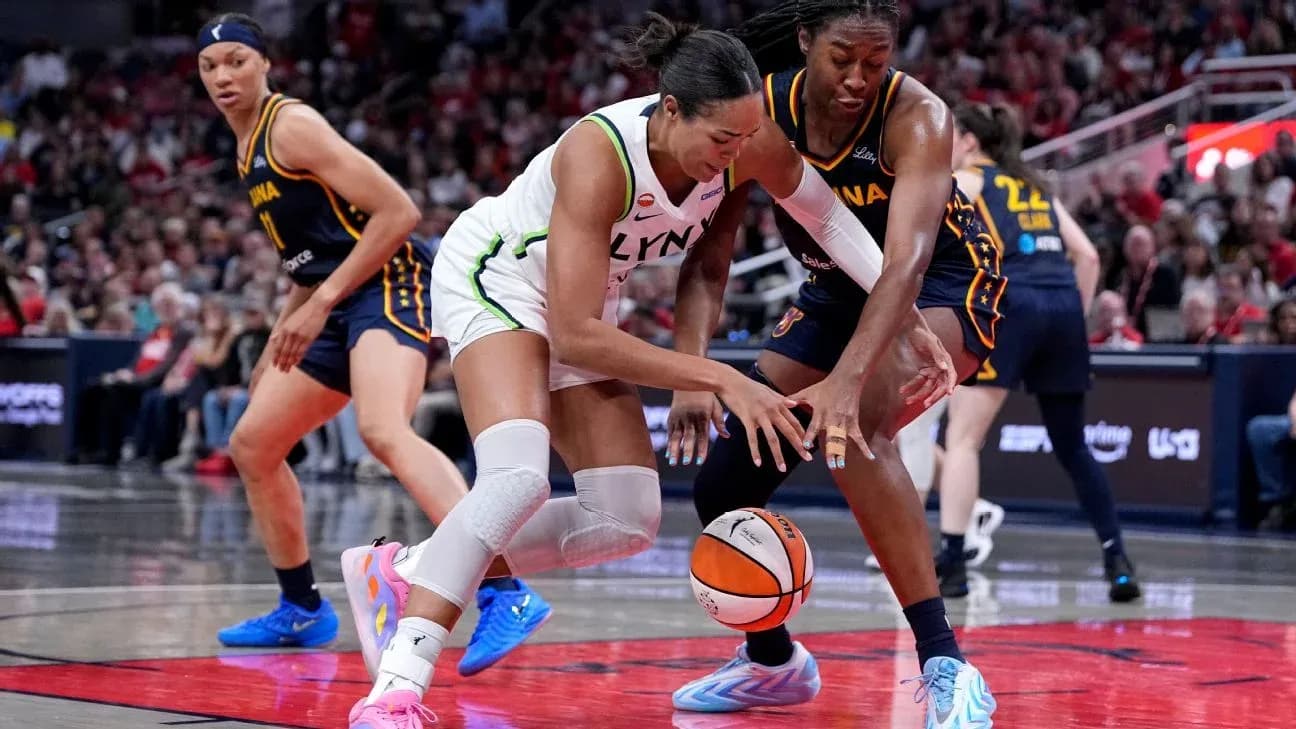
Napheesa Collier is likely to slide from her usual power forward role to small forward, a shift that adds size and strength on the wing without sacrificing mobility. She’s never played in a senior World Cup, but she’s no stranger to the biggest stages, with gold medals from the 2020 Tokyo and 2024 Paris Olympics.
In Paris, she averaged 6.7 points, 6.5 rebounds and 1.3 assists. The numbers are solid; the value goes deeper. Collier defends multiple positions, rebounds above her height, and quietly plugs gaps on both ends. As a bigger three, she can punish mismatches inside, help on the glass and still chase shooters around the arc.
In a tournament where wings often decide who survives the knockout rounds, Collier’s versatility could be the hinge.
Breanna Stewart: The anchor with three golds
Then comes the constant: Breanna Stewart.
Three World Cup gold medals. Tournament All-Star Five in 2022. In that last World Cup run, she averaged 12.8 points, 6.6 rebounds, 3.0 assists, 1.3 steals and 1.4 blocks. Those aren’t just star numbers; they’re “build-the-system-around-her” numbers.
Lawson will likely start her at power forward, but Stewart’s role will stretch far beyond a single position. She’ll be asked to generate paint production, protect the rim and serve as the defensive anchor. When lineups go small or when matchups demand it, she can slide to center and keep the U.S. from losing any structure.
Every contender in Berlin has a focal point. For the U.S., it’s still Stewart.
Aliyah Boston: A new presence in the middle
With Wilson out, the center spot belongs to Aliyah Boston.
She’s not Wilson, and that’s not the point. Boston brings her own brand of interior control: elite one-on-one defense, strong positioning, and the agility to defend in space and still own the paint.
She wasn’t part of the 2026 World Cup Qualifying roster, withdrawing before that competition, but she did feature in the 2024 Olympic Qualifying tournament. There, she averaged 5.0 points, 5.5 rebounds, 1.0 steal and 1.0 block in nearly 23 minutes per game.
Those minutes matter now. Lawson will likely ask her to elevate every part of that profile — to win her matchups on the block, to close possessions with rebounds, to run the floor hard enough to punish slower bigs. With Stewart next to her, Boston doesn’t need to carry the scoring load. She needs to own the dirty work and tilt the paint in the U.S.’s favor.
Firepower off the bench: Clark and Bueckers
If Gray sets the early tone, Caitlin Clark is the change of pace that can flip a game in a few possessions.
She’s expected to be the first guard off the bench, spelling Gray at point guard but also sharing the floor with her in certain lineups. Clark’s World Cup qualifying run in March showed exactly why: 11.6 points and 6.4 assists per game, enough to earn MVP honors in that tournament.
Her vision stretches defenses. Her shooting stretches the floor. Her presence stretches the imagination of what this offense can look like when it’s humming.
Next to her, Paige Bueckers should slot in as the primary backup to Young at shooting guard. Bueckers brings her own brand of two-way play — a calm creator with the instincts to jump passing lanes and the skill to keep the ball moving. She doesn’t need 20 shots to impact a game. She just needs a few minutes of rhythm.
Together, Clark and Bueckers give Lawson a backcourt bench unit that can change tempo, style and spacing in an instant.
Wings and bigs: Copper, Iriafen and Reese
On the wing, Kahleah Copper looms as the likely first option behind Collier.
That’s a punchy one-two combination. Copper attacks downhill, runs the floor hard and defends with edge. When Collier sits, the U.S. shouldn’t lose its aggression on the perimeter. If anything, it might spike.
In the frontcourt, Kiki Iriafen and Angel Reese are the wild cards everyone will be watching.
Iriafen’s energy and length fit perfectly with Lawson’s defensive ambitions. She can back up Stewart, play alongside her, or even slot into smaller, switch-heavy lineups. The exact rotation pattern is still unclear, but her profile screams “early minutes.”
Reese, meanwhile, has been logging time at center this WNBA season as the Atlanta Dream dealt with injuries. That experience could pay off in Berlin. Officially, she’s listed as a reserve in relief of Boston, but her role may stretch beyond a simple backup. She can rebound in traffic, generate second-chance points and bring a physical edge that tends to show up in knockout games.
How Lawson uses Iriafen and Reese — together, staggered, or situationally — will reveal a lot about how she plans to navigate different styles of opponent.
The United States arrives in Berlin without its full complement of stars, but not without answers. There’s enough experience to steady the ship, enough youth to ignite it, and enough versatility to survive the tactical chess match of a long tournament.
The question now isn’t whether this team can win gold.
It’s whether this new mix can keep the dynasty rolling when the rest of the world is closing in.