Team USA Dominates China in 2026 FIBA Women’s Basketball World Cup
Team USA didn’t just open its 2026 FIBA Women’s Basketball World Cup campaign. It planted a flag.
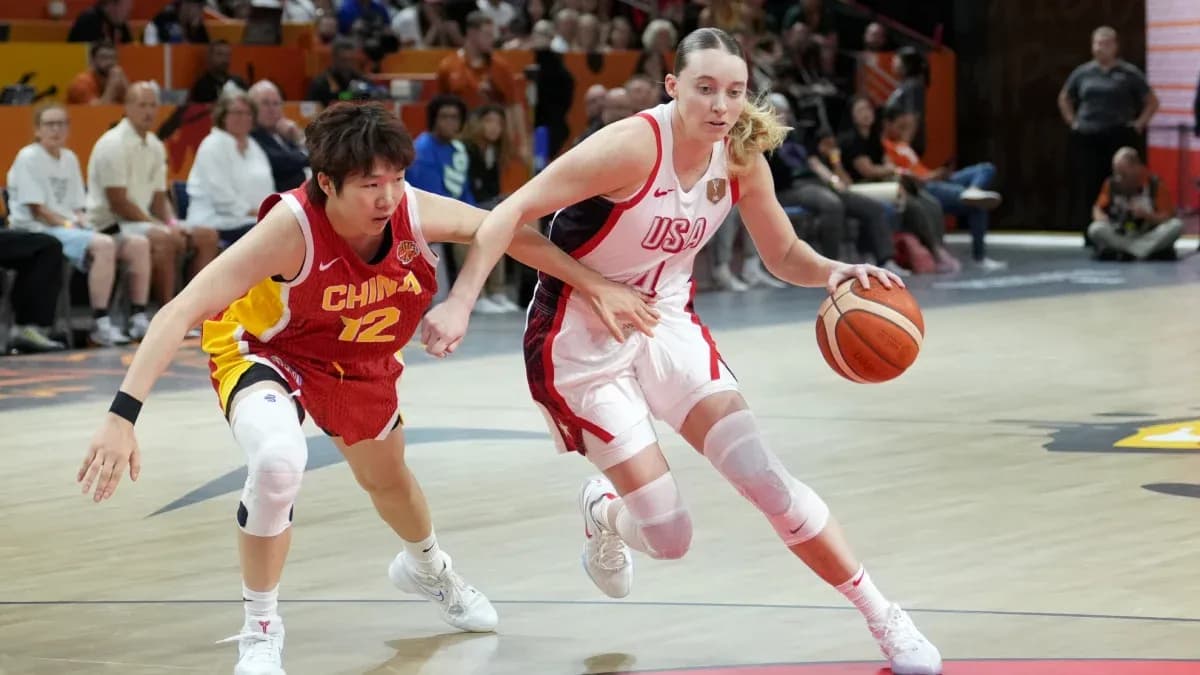
A 94-61 dismantling of China in Berlin on Friday set the tone for a team chasing a fifth straight world title, and did it with enough authority to remind everyone why the United States arrived as the No. 1-ranked side on the planet.
This was the statement win they wanted. Now comes the calculation.
A new format, a familiar target
FIBA’s revamped structure has stripped away some of the old safety nets. Sixteen teams, four groups of four, three games each. Top spot in every group punches a direct ticket to the quarterfinals. Second and third? They get thrown into a single-elimination qualifier just to reach the last eight.
In this format, first place is not a luxury. It’s protection.
Team USA sits in Group D with China, Italy and Czechia. After day one, the picture is already tilting in red, white and blue. The Americans crushed China to move to 1-0 and collect two competition points. Italy beat Czechia, leaving both USA and Italy with matching 1-0 records and an early edge over the rest.
The schedule tightens quickly. USA meets Italy on Sunday, then closes group play against Czechia on Monday. Three games in four days, and the margin for error at the top is slim.
The simple math: one win, but really two
From a qualification standpoint, the path is clear.
One more victory from the remaining two games and Team USA is in the knockout phase. A 2-1 record in a four-team group guarantees a finish inside the top three, which means at least a place in that do-or-die qualification game for the quarterfinals.
But this is Team USA. The bar is never “just get through.”
The real prize is perfection in the group. Go 3-0, finish first, and the Americans skip the extra elimination game entirely and walk straight into the quarterfinals with an extra day to recover and reset. In a tournament packed with elite size, physicality and travel, that rest day could be worth as much as a hot shooting night.
Even 2-1 might be enough to win Group D depending on point differential and tiebreakers, but there’s no need for calculators if they simply beat both Italy and Czechia. They control everything from here.
New faces, same ruthless edge
The opening win over China did more than secure an early lead in the standings. It offered a first real look at a retooled American roster and the way it might evolve over the next two weeks.
Caitlin Clark, making her World Cup debut, looked completely at home on this stage. Fourteen points. Eleven assists. The offense bent around her vision and pace, and China never truly adjusted.
She wasn’t alone. Rhyne Howard poured in 14. Paige Bueckers added 14 of her own. Multiple perimeter threats, all in rhythm, stretched China’s defense to breaking point as the lead swelled to 33 by the final buzzer.
And this came from a group that is not the one many penciled in months ago.
A’ja Wilson and Kelsey Plum, two pillars of recent USA dominance, withdrew before the tournament because of health and injury concerns. Their absence forced a reshuffle. Sonia Citron and Kiki Iriafen stepped into the squad, while the leadership load grew heavier on veterans like Breanna Stewart and Napheesa Collier.
On paper, those are significant losses. On the court in Berlin, the Americans still looked deep, athletic and relentless.
Why first place matters even more this year
The wider field is no soft landing.
France pushed the United States to the brink in the 2024 Olympic final, losing by a single point, and arrived at this World Cup widely viewed as the most serious challenger again. Belgium and Australia have the depth and experience to grind through the bracket and turn any knockout game into a 40-minute fight.
Even China, beaten soundly on Friday, showed why its towering frontcourt remains a problem. Size, length, and a style that can disrupt rhythm for stretches. On another day, against another opponent, that profile can flip a game.
All of that makes the Group D race more than a formality. Finishing first doesn’t just offer rest. It reduces exposure to the chaos of a one-off qualifier, where a cold shooting spell or foul trouble can undo months of preparation in a single night.
Once the quarterfinals begin, the tournament becomes a straight knockout sprint: quarterfinals, semifinals, medal games. No second chances. No back doors.
The expectation: USA to own Group D
Right now, the equation is as straightforward as it gets.
Beat Italy or Czechia, and Team USA locks in a top-three finish and a spot in the knockout rounds. Beat both, and the Americans almost certainly secure the cleanest, most direct route to the quarterfinals by winning Group D outright.
The evidence from Berlin’s opening night backs that outlook. A 1-0 record. A huge point differential. A roster that, even without Wilson and Plum, still overwhelms opponents with a blend of experience, playmaking and depth.
Prediction? Team USA should win Group D and move straight into the last eight.
The more intriguing story will start there. Can France finally turn a near-miss into an upset? Will Belgium or Australia punch through and turn the bracket on its head? Or will this American team, reshaped but still ruthless, carry its streak into a fifth consecutive FIBA Women’s World Cup crown?
The answers won’t come from projections. They’ll come from how this group handles the next two games—and whether anyone in Group D can slow them down at all.