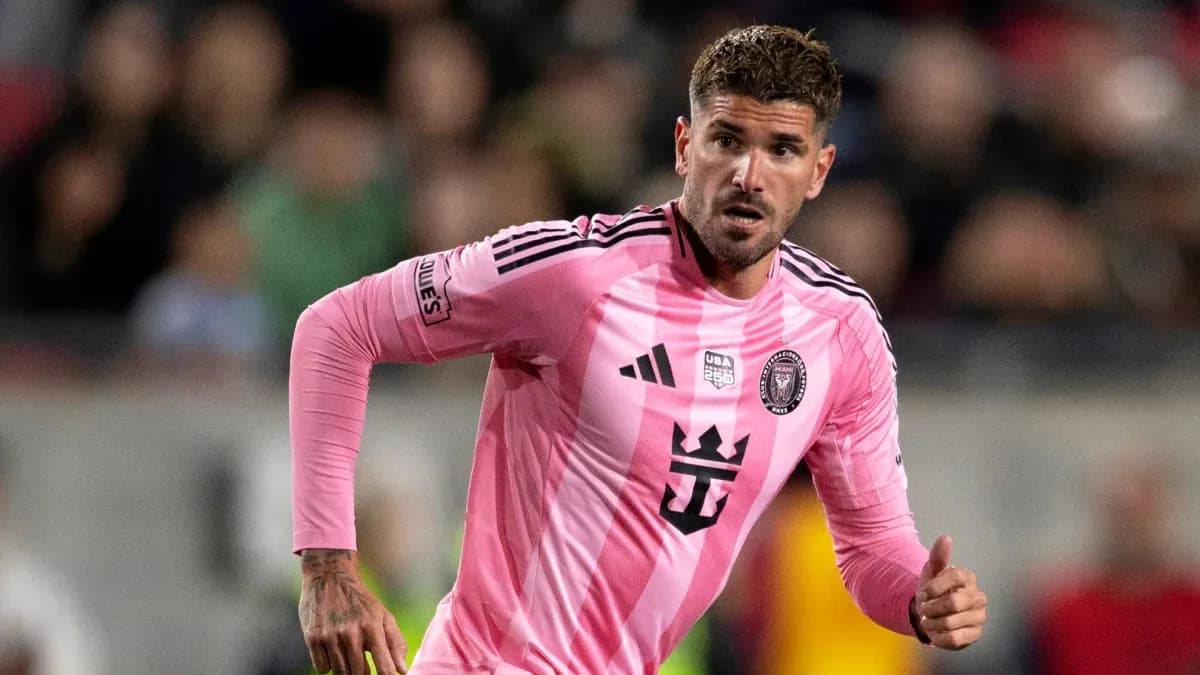
Rodrigo De Paul: From Racing to Riches in MLS
Rodrigo De Paul didn’t hesitate. As tempers flared in Inter Miami’s 1-1 draw with the Chicago Fire, Robert Lewandowski and Ian Fray came together, shoving and snarling in the closing moments. Before the referee could properly intervene, De Paul was already there, charging into the frame, chest out, eyes locked on the Polish striker.
It was raw, emotional, and utterly on brand. This is who De Paul has become: Messi’s bodyguard in pink, the teammate who runs toward the fire, not away from it.
That brief confrontation did more than light up social media. It dragged the spotlight onto a man who has spent more than a decade carving out a career across three continents, building not just a reputation as a relentless midfielder, but a serious personal fortune.
From Racing to riches
De Paul’s journey started far from the MLS glare. He emerged at Racing Club in Argentina, a talented but still rough-edged midfielder trying to find his place in a chaotic footballing ecosystem. Europe came calling early. Valencia took the first gamble, bringing him to Spain and into one of the game’s most unforgiving environments.
His true rebirth, though, came in Italy. At Udinese, across five seasons, De Paul went from promising to indispensable. He became the heartbeat of a mid-table side, a creative force and a fighter rolled into one. That transformation forced bigger clubs to take notice, and in 2021 Atlético Madrid finally moved, paying around €35 million to bring him into Diego Simeone’s iron-grip system.
The fee went to Udinese, not into De Paul’s pocket, but it told the real story: his market value had surged. With it came leverage — the power to negotiate better contracts, bigger bonuses, and stronger commercial deals.
The numbers behind the fire
Today, that rise is written clearly in his bank balance. Celebrity Net Worth estimates De Paul’s net worth at around $25 million. It’s not an official ledger, but as a snapshot of more than 10 years of salaries, bonuses and endorsements in Argentina, Spain, Italy and now the United States, it captures the scale of his climb.
His Inter Miami contract offers the sharpest detail. Figures from the MLS Players Association list De Paul on a base salary of $7.57 million, with approximately $9.69 million in guaranteed annual compensation for 2026. That puts him behind only Lionel Messi and Son Heung-min in the MLS pay table — third in a league increasingly shaped by global stars.
Capology’s estimates underline the trajectory. Across his career, De Paul has earned close to $29.9 million in gross base salary alone, without counting performance bonuses, image rights or sponsorship money. The true total is higher, but even the conservative figure shows how a hard-running midfielder turned his engine into elite-level wealth.
His international success only deepened that. FIFA paid the Argentine federation $42 million for winning the 2022 World Cup, though it never disclosed individual player shares. The same goes for his bonuses from lifting the Copa América in 2021 and 2024 — no official breakdowns, no verified numbers, only the certainty that those medals came with serious financial rewards attached.
A different kind of pride
Lewandowski’s résumé glitters with club trophies: Champions League, Bundesliga titles, goal-scoring records. De Paul’s pride lives in another space.
He became the tireless midfielder at Messi’s side, the one who runs, presses, fouls when needed and then sprints again. Two Copa América titles and a World Cup crown have defined his international legacy. He built his identity on work and loyalty — the player who will argue with anyone, anywhere, if it means protecting the crest or the teammate next to him.
That instinct exploded in that late clash with Chicago. Lewandowski pushed Fray. Fray pushed back. De Paul arrived like a storm. It wasn’t about the scoreboard. It was about hierarchy, about message, about showing that Inter Miami’s stars will not be pushed around.
Life beyond the pitch
Away from the stadium lights, De Paul’s story is anchored in family. He is the youngest of three sons born to Mónica Ferrarotti and Roberto De Paul, a dynamic that often shapes the competitive streak of the baby of the house. He has two children, Francesca and Bautista, from his former relationship with Camila Homs, and that personal life has frequently spilled into the public eye in Argentina, sometimes rivaling his football for headlines.
His years in Europe — roughly 11 in total from his 2014 move to Valencia to his 2025 departure from Atlético Madrid to Inter Miami — also reshaped him off the field. He developed a keen interest in fashion, curated his image carefully and turned his body into a canvas. The tattoo on his neck, marking the date of Argentina’s 2022 World Cup triumph, is not subtle. It is a permanent, visible declaration of the greatest night of his career.
That ink tells you as much about him as any salary sheet. The money matters, of course. The contracts, the bonuses, the endorsements — they explain how a kid from Racing built a multimillion-dollar life. But the way he sprinted into that confrontation with Lewandowski explains something else.
Rodrigo De Paul has earned his fortune. He’s still earning it. And as long as he’s on the pitch, anyone who goes after his teammates will find out exactly why he’s worth every dollar.