Pakistan's Historic Collapse in Third Test: A Gloomy Day at Edgbaston
The clouds hung low over Edgbaston, heavy and sulking, but even they struggled to match the mood inside Pakistan’s dressing room. By lunch on day one of the third Test, the tourists had slumped to 100-7, their series and their spirit sagging in unison.
Downcast barely covers it.
This was supposed to be the reset. A raft of controversial changes from the Pakistan Cricket Board, billed as shock therapy, had been sold as the jolt that would revive a listing Test side. Instead, the defibrillator has misfired. Twenty-three overs into the match, Pakistan’s innings already looked terminal, their cause in Birmingham close to hopeless.
Anyone holding tickets for day three might be tempted to start thinking of alternatives.
Records no team wants
The collapse was not just ugly. It was historic.
With the Thwaite Memorial scoreboard showing a meagre 48, Pakistan’s entire top five had been sent back. All of them dismissed for single figures. It is only the 12th time in Test history that a top five has collectively failed to reach double figures – and the first time it has happened in a first innings.
The numbers tell an even bleaker story across the series. No touring side in England has ever started its innings worse than Pakistan are doing now.
Their second wicket has fallen at 6 and 13 at Leeds, 16 and 7 at Lord’s, and 14 here at Edgbaston. That’s 56 runs in total before the second wicket across the series. An average of 5.6 runs for the first wicket, 11.2 for the fall of the second. They are on course to undercut a record that has stood since 1888, when Australia averaged 16 for the loss of their second wicket in an English series.
Former Pakistan captain Ramiz Raja did not sugar-coat it.
Pakistan’s “technique and mindset” were “pretty ordinary”, he said on Test Match Special. “There’s mental fatigue and turmoil in the dugout, I can understand that. But from an individual point of view, I think Pakistan have been waiting for the ball to come and damage them completely. They have not been proactive at all. They have to have a plan. This is a flat pitch, it’s not a demon-like pitch, like the third day at Lord’s.”
England smell blood
England, for their part, were ruthless.
Joe Root won the toss under autumnal skies and had no hesitation in unleashing a four-man seam attack that quickly found its rhythm. They were disciplined, relentless, and just mean enough to expose every technical crack on show.
Former England captain Michael Vaughan summed up the imbalance. Pakistan, he said, were “clearly shot for confidence” after “such a disastrous morning”.
“I feel for Pakistan because this is embarrassing with everything they’ve had to cope with in the last week,” Vaughan added.
Embarrassing is a strong word. It also felt accurate.
Pakistan’s batters combined poor judgement with a pitch that, while not treacherous, certainly misbehaved enough to keep them guessing. CricViz’s bounce inconsistency rating put this surface at 5.7 – far higher than the 2.6 against India in 2025, 3.2 against West Indies in 2024, or 3.3 against Australia in 2023.
So yes, the ball did plenty. But not enough to excuse everything that followed.
Rust, rash strokes and a captain under siege
There is room for sympathy in this mess. Saim Ayub, one of the new faces parachuted in for this Test, has not played a first-class match since October 2025. Tossing him in at the top of the order against Ollie Robinson, under low cloud in Birmingham, felt less like an opportunity and more like an inevitability.
From the moment he marked his guard, his dismissal seemed pre-ordained.
Yet the more experienced hands were just as culpable. Once the early damage was done, Pakistan needed discipline, time at the crease, and a little stubbornness. Instead, with four down, Saud Shakeel and Babar Azam went the other way, throwing their hands through expansive drives outside off stump.
Two batters in their thirties. Two players with enough Test cricket behind them to know better. Both flirting with risk when survival was the only currency that mattered.
The numbers underline the chaos. Pakistan’s false-shot percentage in the morning session was 40% – the second highest in the opening session of a Test since 2006. This was not stoic resistance on a minefield. It was a side lurching between caution and recklessness, often in the same over.
Saud made it to lunch. Babar did not.
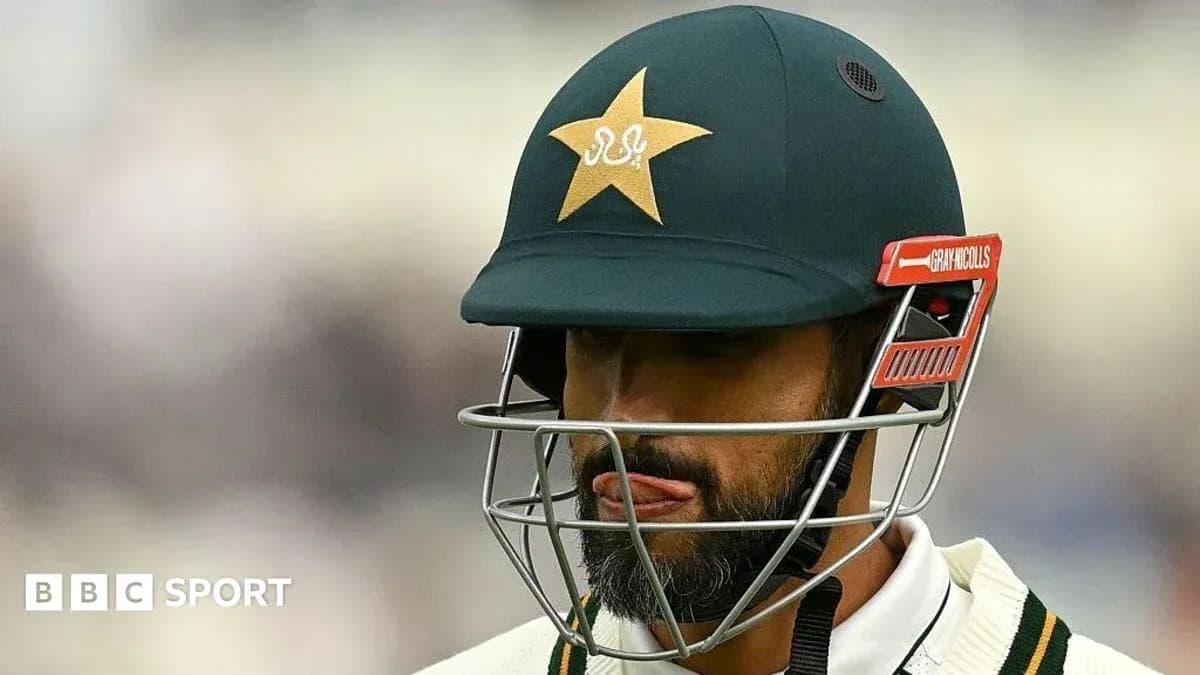
About 40 minutes before the interval, he was bowled by Josh Tongue, undone and then left gesticulating at the pitch, as if it were the main culprit. It was a telling image: a captain trying to find something, anything, to blame in a situation spinning away from him.
“He [Babar] disintegrated. It’s tough for him,” Ramiz said. “He’s got to explain all this mayhem and then he has to look after himself and then he’s got to work with the lot that are more T20 in nature than Test cricket. This innings is in serious turmoil.”
Turmoil is the right word. Babar stands at the centre of it: the figurehead of a side whose Test identity looks increasingly blurred, leading a group many see as better suited to the chaos of T20 than the grind of five-day cricket.
A series slipping away
By lunch, the gloom around Edgbaston was no longer just in the sky. It had settled over Pakistan’s tour, over their selection gambles, over a batting order that keeps finding new ways to fold.
The pitch has its quirks. England have bowled well. The schedule, the noise, the off-field upheaval – all of it weighs heavily. But the cold truth is that Pakistan are not just being beaten. They are unravelling.
If this is the response to the board’s “shock treatment”, what comes next for a team that looks increasingly short of answers, as well as runs?