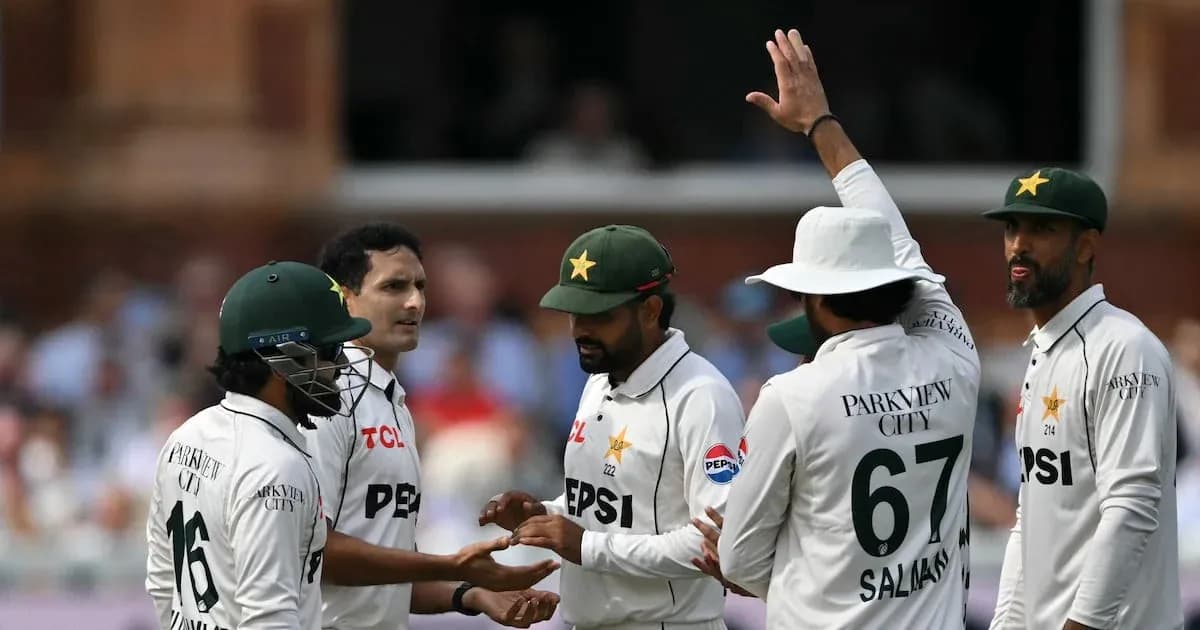
Pakistan Faces Crisis Ahead of Edgbaston Test After Dramatic Squad Overhaul
Pakistan arrive in Birmingham this week not so much chasing a consolation win as sifting through the debris of a tour gone badly, publicly wrong.
Two crushing defeats have already settled the three-match series in England’s favour. An innings hammering at Headingley, followed by a 194-run loss at Lord’s, has left Pakistan outplayed, out-thought and, now, almost unrecognisable.
A cull in the middle of a series
The response from Lahore was as dramatic as anything that has happened in the middle. The Pakistan Cricket Board did not tweak around the edges; it detonated the squad.
Seven players were sent home. Seven replacements were summoned, five of them uncapped at Test level. In the same breath, the PCB sacked Test coach Sarfaraz Ahmed and bowling coach Umar Gul, parachuting in Pakistan’s white-ball duo Mike Hesson and Ashley Noffke to pick up the pieces.
Salman Ali Agha, who had captained at Headingley when Babar Azam was injured, was among those jettisoned. So was left-arm spinner Ali Usman, fresh from a five-wicket haul in that very match. Experienced wicketkeeper Mohammad Rizwan was told to go. Imam-ul-Haq, nursing a calf injury that kept him from batting in either innings at Lord’s, also found himself on the flight home.
This was no quiet reset. It was a purge.
Hesson, only just installed and already firefighting, did not pretend this was normal. “The guys are probably more used to a little bit of chaos than I am. I don’t think anyone wants this to happen in the middle of a series,” he said last week.
The New Zealander’s task is brutal in its simplicity: pick a team that can compete, and do it on the fly. “From my perspective, it is about putting a balanced squad together, not only for this Test, so we actually have some variety in our attack. Pakistan is known for the pace, unusual actions, mystery spin – we haven’t really been able to present any of that.”
He now has to conjure it at Edgbaston, with a group that has barely met, let alone played together.
Fingers pointed at the top
The on-field failures have quickly bled into a wider reckoning. Azhar Ali, part of the side that climbed to No 1 in the Test rankings a decade ago, has not held back.
For him, the rot runs through the office of Aaqib Javed, the PCB’s high performance director since 2024. “Every decision he makes backfires, and he then says: ‘It’s not me’,” Azhar told the Guardian, a stinging assessment echoed by former Pakistan coach Jason Gillespie, who said Javed needed to “look at himself in the mirror”.
Those comments landed with enough force for the PCB to announce, on Monday, an investigation into the squad’s conduct in England. The optics are grim: a team losing heavily on the field while the board investigates what is happening off it.
Yet the more immediate problem for the new arrivals is far more basic. There are no tour games between Lord’s and Edgbaston. No time in the middle, no chance to feel out English conditions, no gentle introduction to the Dukes ball under low skies.
They will be learning on the job against a rampant attack.
England’s “perfect storm”
Joe Root, restored as England captain and already with a series win in his pocket, described the conditions at Lord’s as a “perfect storm” for bowlers: seam-friendly pitches, heavy cloud, and balls that never seemed to soften. Batting has been hazardous for both sides, but only one has found a way to live with it.
Pakistan have yet to reach 200 in any of their four innings. Their top order has been shredded repeatedly by an England pace unit that looks fresh, varied and hungry. Ollie Robinson’s relentless accuracy, Jofra Archer’s hostility, Josh Tongue’s awkward bounce and Gus Atkinson’s pace have formed a quartet that bears little resemblance to the weary, scattergun attacks England fielded at the end of the Bazball era.
The contrast has been stark. Where England have tightened up, Pakistan have unravelled.
For Root, the challenge now is not about rescue but ruthlessness. England have their first Test series win in over a year. They have a returning captain who has slipped back into the role with the ease of a man who never truly left it. The job in Birmingham is to finish. To turn a turnaround into a statement with a 3–0 whitewash.
A win… or another illusion?
Back in Pakistan, the mood is darker. This is not the old, romantic idea of a mercurial side capable of brilliance one day and chaos the next. The numbers are harsher than that. Fifteen defeats in their last 20 Tests tell a different story: not unpredictability, but a grim, grinding pattern of failure.
“We’ve become totally consistent – in the most negative way,” Azhar Ali lamented. It is a line that cuts to the heart of the current crisis.
That is why even the prospect of an upset at Edgbaston carries a twist. For some Pakistan supporters, the fear is not that their team will lose again, but that they might somehow win, and that a single stirring performance will be used to gloss over a dysfunctional structure and a string of bad decisions.
Edgbaston, then, is more than a dead rubber. For England, it is a chance to underline a new, harder edge. For Pakistan, it is a stark question: is this the start of a reset, or just another wild swing in a system that no longer knows what it wants to be?