Ollie Robinson: The Summer That Redefined English Seam Bowling
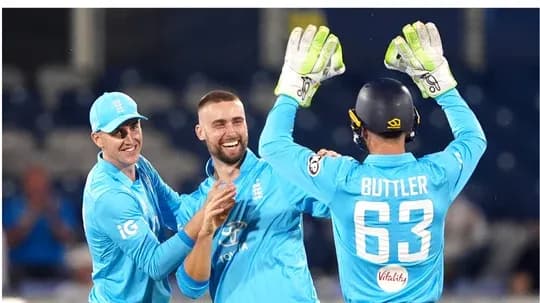
Matt Henry had his days. Nathan Smith had his spells. Mohammad Abbas, with that familiar, almost lazy rhythm, kept batters groping at shadows. But when the English summer of 2026 is replayed in the mind, it will belong to one man.
Ollie Robinson didn’t just return. He rewrote the terms of engagement.
Medium pace, maximum damage
The numbers are outrageous. Robinson has averaged 7.96 with the ball this summer. Not a typo. Not a quirky three-Test burst either – 26 wickets in four matches, with another innings still to come, and a Player-of-the-Match medal in each of his first three outings.
Henry sits next on the list at 13.33, Abbas at 20.80. Josh Tongue and Jofra Archer have both had strong seasons at opposite ends of the speed gun, but no one has matched Robinson’s ruthless efficiency.
This has been a summer that restored the reputation of the so-called “medium” bracket. Anything under 80mph has been far from gentle. Balls in that band have taken 40 wickets at 17.92, striking every 33.4 deliveries and going at just 3.21 an over. The faster stuff – above 80mph – has brought three times as many wickets overall, but at a higher average of 23.38.
Only once in the ball-tracking era has sub‑80mph bowling been more effective: 2019, when 26 wickets at 17.42 were logged, 13 of them by Ireland in that frenetic three-day scrap at Lord’s.
This year, conditions have conspired to reward skill over speed. Seamers have operated in a sweet spot where the expected average sits at 23.6; they’ve beaten even that, delivering an actual average of 22.14. This hasn’t been a grind where bowlers had to manufacture miracles. The pitches, the Dukes ball, the air – all combined to tilt the contest towards the ball.
The method has followed. Wobble seam has been the trick of the trade, and the stumps have become the main prize.
Stumps, not slips
The traditional English template is familiar: fourth-stump line, patient fields, cordon busy, keeper and slips in the game all day. This summer has torn that up.
Bowled and LBW dismissals have accounted for 45.6% of all wickets – the highest proportion in any English summer since the Second World War. The ball hasn’t just kissed the edge; it has hunted the pads and the timber.
That’s where the medium pacers have found their window. With keepers standing up more often, they’ve attacked the stumps with movement rather than chasing the nick. The plan has been simple, brutal and effective: make batters defend their stumps against a ball that refuses to behave.
No one has embodied that better than Robinson.
He has induced more false shots than any bowler in an English season for which data exists. His false-shot rate sits at a staggering 39.7%. Two balls in every five provoking a misjudgment. Abbas, second on the list this year, trails at 32%.
The ball isn’t flying past the edge. It’s dragging batters into strokes they don’t want to play, then punishing them for it.
Two years out, one ruthless reinvention
All of this lands differently when you remember where Robinson stood two years ago.
Despite exceptional early numbers – 102 wickets at 19.10 in 24 Tests, with an innings still in hand – he vanished from England’s plans in early 2024. Brendon McCullum’s regime wanted more pace to crack Australia, and Robinson, for all his craft, didn’t fit the brief.
Stack his record against Jasprit Bumrah at the same stage and it looks even more striking. Bumrah had 101 wickets at 22.79. Robinson’s 102 have come at 19.10. His strike rate of 42.5 compares to Bumrah’s 51.4. Robinson has six Player-of-the-Match awards already; Bumrah had one at that point.
Since Robinson’s debut in 2021, only Travis Head has more POTM gongs – 10 in 48 Tests. Robinson’s six have arrived in just 23, meaning he walks away with the award in more than a quarter of his matches. No one else touches that share.
Yet the story of his comeback isn’t about what he kept. It’s about what he stripped away.
He has moved away from swing and leaned into seam. In his debut summer of 2021, his average swing sat at 1.06 degrees. This year, it’s down to 0.55. Seam movement, though, has gone the other way – up from 0.72 to 0.85 degrees.
The length has tightened too. In 2021, 61.2% of his deliveries landed in the good-length zone. In 2026, that figure has jumped to 69.5%.
He now charges in, hits that 6-8 metre zone over and over, and lets the wobble seam do the lying. Batters see a ball they think they recognise. They don’t.
A new angle, a new victim: the left-hander
The transformation has been especially brutal for left-handers.
Between 2021 and 2024, Robinson averaged 28.32 against them. Respectable, not terrifying. This year, that number has crashed to 6.60. Eleven wickets from just 262 balls.
The method is familiar in theory but newly lethal in his hands: around the wicket, angling in, threatening the stumps, and using late seam to drag the ball either way.
From 2021 to 2024, only 37% of his deliveries to left-handers came from around the wicket. He took seven wickets from 584 balls at 39.28 from that angle. In 2026, 80% of his balls to southpaws have come from around the wicket – and they’ve yielded ten wickets in 210 balls at 6.20.
Same bowler, different geometry. The shift in angle has changed everything.
The milestone that fit the moment
All of this refinement, all of this recalibration, crystallised in one landmark moment.
On the first morning of the third Test, Robinson took his 100th Test wicket. The victim? A left-hander, Saim Ayub, pinned in front by a nip-backer from around the wicket. The very blueprint of his reinvention, executed perfectly.
He reached the hundred in just 4285 balls – the fifth-fastest in the post-war era, behind only Dale Steyn, Vernon Philander, Waqar Younis and Kagiso Rabada. That is rarefied air.
At that point, his career average stood at 19.10 – the sixth best among 206 bowlers with 100 or more Test wickets, and the best in the last 100 years. His home average of 16.05 placed him fourth all-time (minimum 50 wickets), again the best of the last century.
These are not the numbers of a handy seamer. They are the numbers of a bowler bending an era to his will.
Medium pace, modern edge
This has been the summer that dragged medium pace back into vogue. Not as a throwback, but as a cutting-edge craft.
Robinson has shown how a bowler can read what England offers – helpful surfaces, responsive balls, a game increasingly obsessed with speed – and still find a way to dominate at 80mph and below.
He has reduced his reliance on conventional swing, committed to wobble seam, hammered the good length more often and built a devastating plan to left-handers from around the wicket. His career home record was already elite; this summer, he has sharpened it into something that looks historic.
He no longer feels like a relic of England’s old-school seam-bowling culture. He feels like its most refined version.
In a season when stumps have mattered more than the cordon, Robinson has been the bowler who keeps batters guessing after the ball lands, not before. If he can hold this level, the question for England is no longer whether he fits their vision.
It’s how long they can build an attack around him.