Noah Atubolu's Journey from Freiburg to Eintracht Frankfurt
Noah Atubolu walked away from the comfort of home this summer and, for a while, found nothing waiting for him.
The Freiburg academy product had decided early: no contract extension, no compromise, no more games for the club that raised him. His deal ran until 2028, but as soon as last season ended, everyone knew the relationship was over. Freiburg moved quickly, paid Werder Bremen twelve million euros for Mio Backhaus, and closed the goalkeeping chapter on Atubolu.
For the 24-year-old, the script was supposed to be different. Premier League lights, a big move, a clear next step. Instead, the market stayed cold. Offers did not arrive in the volume or at the speed he expected. Sport Bild summed up the mood in June with a brutal line: “He has completely overplayed his hand.” By then, the bridge back to Freiburg had already burned.
So Atubolu waited. Watched options in England fade. Watched the summer window tick away. A goalkeeper without a club he could actually play for, a talent in danger of drifting.
Eintracht Frankfurt changed that story late.
At the end of August, the Hessian club came in and paid Freiburg a one-million-euro loan fee. It was not just a short-term patch. Built into the deal is an obligation to buy: if Eintracht avoid relegation this season, the transfer becomes permanent. Given the ambition and quality in Frankfurt’s squad, the condition looks less like a risk and more like a timetable.
The numbers are clear. Twelve million euros more next summer, a long-term contract until 2031, all negotiated by former sporting director Markus Krösche before his departure. For a goalkeeper who spent most of the summer in limbo, it is a remarkable turnaround.
Eintracht, for their part, had their own doubts to resolve. In the weeks before Atubolu arrived, it became obvious inside the club that starting the season with Kaua Santos as undisputed number one was not the plan anymore. They needed experience, presence, a keeper ready to walk straight into the Bundesliga.
Atubolu did exactly that.
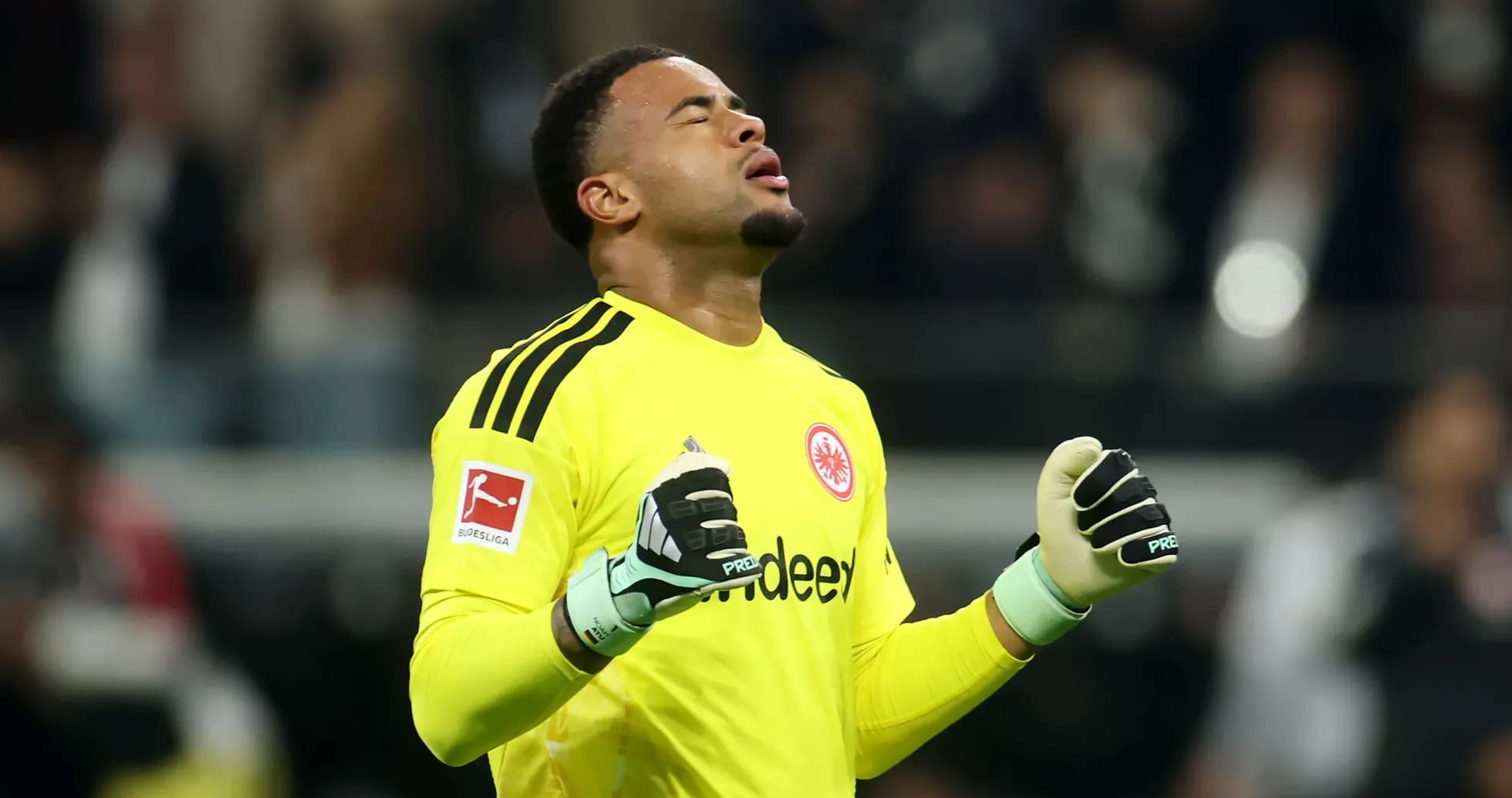
One day after signing, he stood in goal for Frankfurt’s Bundesliga opener away at Union Berlin. A wild 3-3 draw, a baptism in chaos, but also a clear message: he was not here to sit on the bench and wait his turn. Since then, he has made eight appearances in all competitions, growing into the role with every game.
The adaptation off the pitch has moved just as fast. According to Bild, Atubolu has settled quickly in Frankfurt, both in the dressing room and in the city on the Main. He is reportedly already part of the players’ council, a sign of how teammates and staff view his character and influence. Goalkeepers often take years to gain that kind of internal authority. He has needed weeks.
The long-term picture is starting to sharpen. The Premier League remains his dream, and he has never hidden that. But the structure of this deal hints at something else: stability. Reports that his Eintracht contract does not include a release clause suggest the club see him as a cornerstone, not a trading asset.
From a summer of miscalculation to a future tied to Frankfurt’s survival, Atubolu’s gamble has taken on a new shape. If Eintracht do what they expect to do and stay clear of the drop, the obligation to buy will kick in and lock both sides together until 2031.
The question now is no longer whether he overplayed his hand in June. It is how far he can stretch it in Frankfurt – and whether the road to the Premier League might one day run straight through the Waldstadion.