Michael Carrick Faces Hard Truths at Manchester United
Michael Carrick is still in a job. For now.
Eight games without a win, 16th in the table, one point above the relegation zone – this is not how Manchester United imagined the season unfolding, nor how their head coach imagined his first serious crisis in the role. Yet here he is, preparing for Chelsea away, talking openly about “hard truth” and uncomfortable conversations at every level of the club.
Hard truths at the top
Carrick did not pretend this has been business as usual. His discussions with director of football Jason Wilcox and chief executive Omar Berrada have been frank, and at times, raw.
“It’s pretty clear, it’s not always rosy and nice conversations between anyone, whether that’s between me and the players, whether that’s between me, Jason, Omar or the owners,” he said. “It’s the truth, it’s the hard truth at times and it’s what we need to move forward. Whatever we need to move forward, we will do.”
That line tells its own story. After last Sunday’s 3-0 defeat to Bournemouth, his position was under genuine threat. United looked lifeless, the atmosphere around the club toxic, the league table unforgiving. The board stopped short of pulling the trigger, but the message is clear: this is a reprieve, not a reward.
Chelsea at the weekend now feels less like another fixture and more like a test of whether this regime has any real pulse left.
Applause for the manager, boos for the team
The scenes at Old Trafford after the Bournemouth defeat captured the strange, conflicted mood around Carrick’s United.
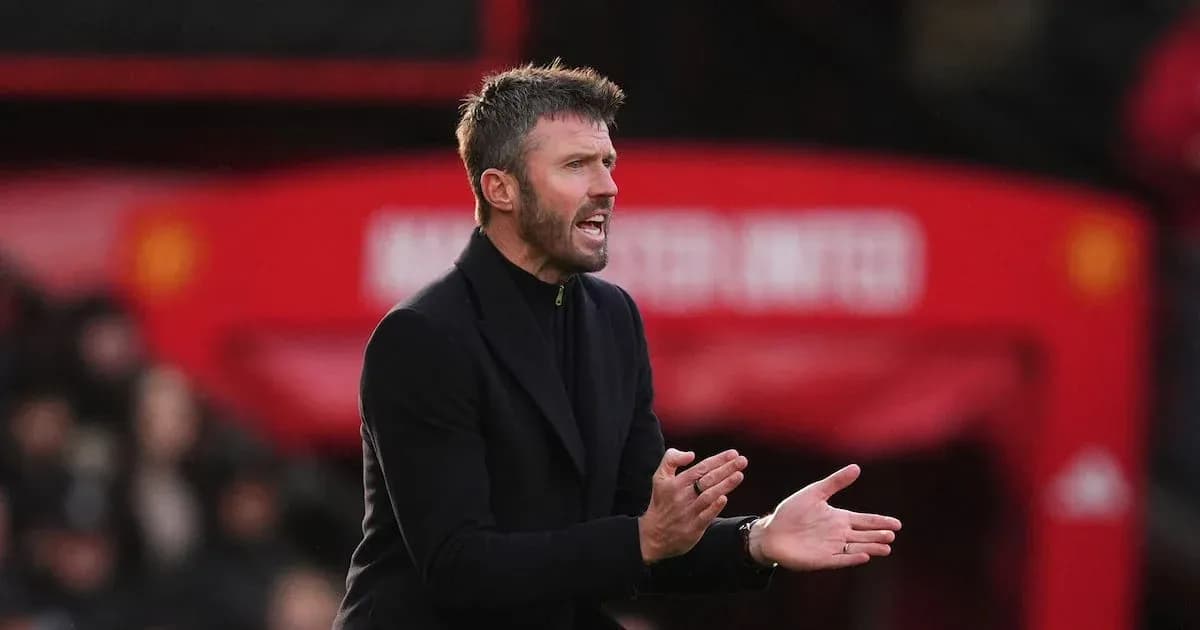
As the players trudged off, Carrick stayed out on the pitch, completing a slow lap in front of supporters who chose to back him rather than turn on him. They applauded, they sang, they showed him a level of respect that has not been extended to the team. Once he disappeared into the tunnel, the mood turned. The players were loudly booed, their performance and perceived lack of effort savaged from the stands.
Carrick admitted the moment left him torn.
“I’ll be totally honest, it was mixed feelings for me,” he said. “To have the appreciation from the supporters and that connection and that respect is something I feel strongly about.
“It wasn’t a nice situation but to feel that was important, of course, but it didn’t make me feel better in the fact that I’m with the players 100% and we’re all in it together. I’ve told the players that, I’m happy to say that.
“I didn’t feel comfortable being in any way, shape or form, a separation from that. That’s my group, my players and this is my football club so we have to all be in it together, and that’s the supporters included.”
That is a manager trying to close a widening gap. The fans have picked their side – they see Carrick as one of their own, a former player, a figure of dignity in a chaotic era. The squad, by contrast, is under suspicion. Carrick knows that dynamic can be dangerous. Publicly distancing himself from his players might buy him time, but it would destroy the dressing room he needs to rescue him.
“As hard as it is at the moment, I totally get that, I get their feelings,” he added of the supporters. “But when we get through this then we’ll be a lot stronger as a whole.”
The promise is bold. The path to fulfilling it is anything but clear.
Players “hurting” – and under fire
Inside the dressing room, Carrick insists the reaction has been one of pain, not apathy.
He says the players are “hurting” and “hungry” to put things right, words that will be tested in every tackle and sprint at Stamford Bridge. United’s slump has not just been about results; it has been about a sense that standards have slipped, that the badge is weighing lighter on some shoulders than it should.
Gary Neville, never shy when it comes to his former club, sharpened that criticism this week. On his podcast, he questioned the professionalism of certain members of the squad, going beyond tactics or form and straight for lifestyle.
“I’ve got no time for them,” Neville said. “There’s a few of them that don’t go to bed at the right time. Don’t eat the right things.”
It was a pointed accusation, aimed squarely at the culture around the team. Carrick chose not to bite. Asked about Neville’s claims, he responded with a wry smile and a short, dismissive line: “Gaz says a lot of things.”
No public rebuke. No agreement either. Just enough distance to show he will not conduct his man-management via podcast, but not enough to shield his players from the criticism entirely.
A club on the brink of a response
This is where Manchester United find themselves: a manager fighting to keep the dressing room tight, a hierarchy demanding change, a fanbase that has separated its loyalty between the man on the touchline and the men on the pitch.
Carrick has been given the chance to turn it around, starting at Chelsea. The conversations have been had. The “hard truth” has been laid out. The question now is whether this squad is willing – or able – to respond when it matters most.