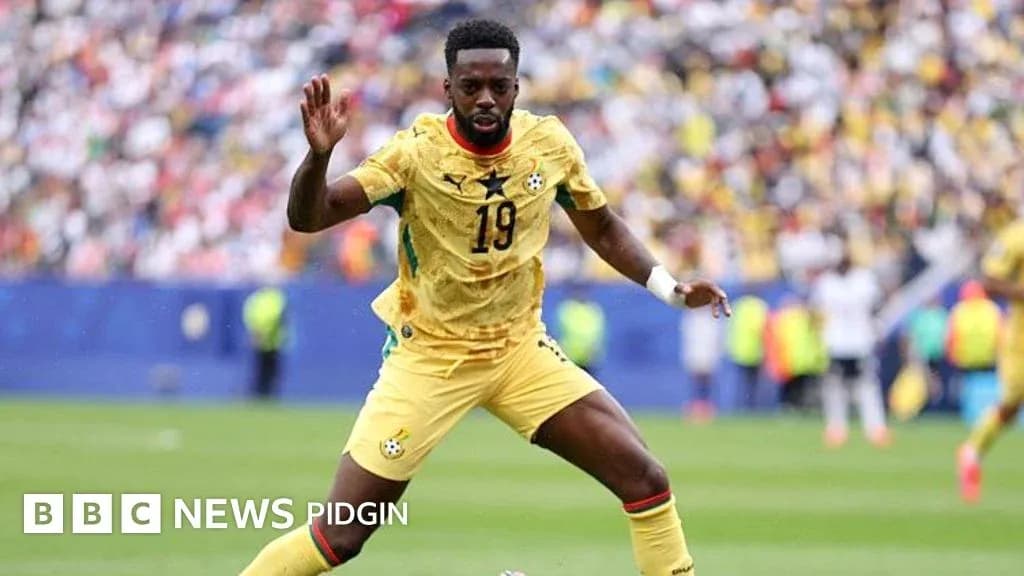
Inaki Williams Retires from Ghana National Team
Inaki Williams has drawn the curtain on his international career with Ghana, bringing a brief but emotionally charged spell with the Black Stars to a close.
The Athletic Bilbao forward announced his decision on Friday, 11 September 2026, posting on his X account that he leaves the national team “happy, proud and with the peace of mind” that he gave everything whenever he wore the shirt.
“I feel the time has come to bring my journey with the Ghana national team to an end. I leave happy, proud and with the peace of mind of knowing that I gave everything every time I wore this shirt,” he wrote, confirming what many around the camp suspected after the World Cup.
His last act in Ghana colours came at the 2026 FIFA World Cup, a campaign that promised more than it delivered. Ghana exited the tournament after a narrow and bruising 1–0 defeat to Colombia, a result that cut deep given the confidence built from earlier group-stage performances against Panama and England, where the Black Stars kept two clean sheets and looked structurally solid.
The pressure of the knockout stage told. Ghana’s resilience, which had defined their group, could not find a response to Colombia’s single, decisive blow. For Williams, it proved the final chapter.
A late embrace of Ghana
Williams’ international story has always carried an extra layer of meaning. Born in Spain to Ghanaian parents, he first emerged on the radar of Spain’s national setup and, for years, seemed destined to wear La Roja.
He received his first international call-up with Spain’s under-21 side in March 2015. That pathway, however, never fully opened. Despite his appearances at youth level, he did not make a major competitive appearance for Spain’s senior team.
In 2021, when asked about the possibility of switching allegiance to Ghana, he spoke candidly about identity and upbringing, noting that while his parents came from Accra, he had not been born or raised there and that his culture was rooted in Spain.
The story turned on 5 July 2022. Williams announced that he would represent Ghana, committing to the Black Stars ahead of the 2022 FIFA World Cup. It was more than a footballing decision. It was a return.
“Ghana has given me so much, more than football. It has allowed me to come back home, feel even closer to my roots and experience the enormous pride of representing my country and wearing this flag on my chest,” he reflected in his farewell message.
That sense of homecoming defined his time with the national team, even if the trophies and deep tournament runs never arrived.
Roots, risk and relentless work
Williams’ journey to the top level of European football is inseparable from his family’s story. Born to Ghanaian parents who entered Spain after crossing the Sahara desert on foot and jumping the Melilla border fence, he grew up with a clear understanding of sacrifice and survival.
Those early hardships framed his rise. He spent his childhood honing his game in Spain before Athletic Bilbao spotted him at 18 and brought him into their youth ranks. Within a year, he had broken through.
He made his La Liga debut for Athletic’s first team in 2014 and scored his first goal in February 2015. From there, he evolved from promising youngster to cornerstone of the side. One of the standout moments of his club career came in the Spanish Super Cup final, when he scored a spectacular long-range goal – from around 20 metres – against Barcelona, underlining his capacity to decide big matches.
In 2019, Athletic Bilbao underlined their faith in him with a remarkable nine-year contract, one of the longest deals seen in modern football. It still falls short of the famous 10-year agreement Real Betis once handed Brazilian winger Denilson in 1998, but it placed Williams among a rare group of players tied to a club for almost a decade.
A chapter closes, the bond remains
Williams’ decision to retire from Ghana duty is not a step away from the country, only from the international stage. He made it clear he will continue to support Ghanaian football and the Black Stars from afar.
He leaves with no major tournament triumphs, but with something harder to quantify: a bridge between generations of Ghanaians at home and in the diaspora, and a visible symbol of what it means to embrace one’s roots later in life.
The Black Stars will move on, as national teams always do. New forwards will emerge, new heroes will write their own stories. Williams, though, has already chosen his role in the next act: not on the pitch, but in the stands and in spirit, backing the shirt he once fought so hard to earn.