Fede Valverde's Transformation: From Midfielder to Right-Back
Fede Valverde needed less than half an hour in Athens to change everything.
Thrown on from the bench, he grabbed hold of a drifting game and bent it to his will. He tidied up Madrid’s midfield, became their main source of danger with three created chances, and then, from around 25 metres, he ripped a shot that tore past Alberto Brignoli and into the net with brutal, rising power.
That strike, Real Madrid’s third of the night according to AS, did more than seal a seventh straight win. It kept the mood light and loud at Valdebebas, pushed the club closer to locking down a place among the top eight, and dragged Valverde back to a version of himself many thought had faded – the all-action midfielder who once flourished under Carlo Ancelotti, scoring from distance and bossing games from the centre of the pitch.
Back then, Ancelotti had been the one to first flirt with a different idea. In the closing minutes of a Champions League tie against Sheriff Tiraspol in 2021, he slid Valverde out to full-back, more out of necessity than conviction. It felt like a tactical footnote.
Now it feels like a blueprint.
From “not born a full-back” to Mourinho’s solution
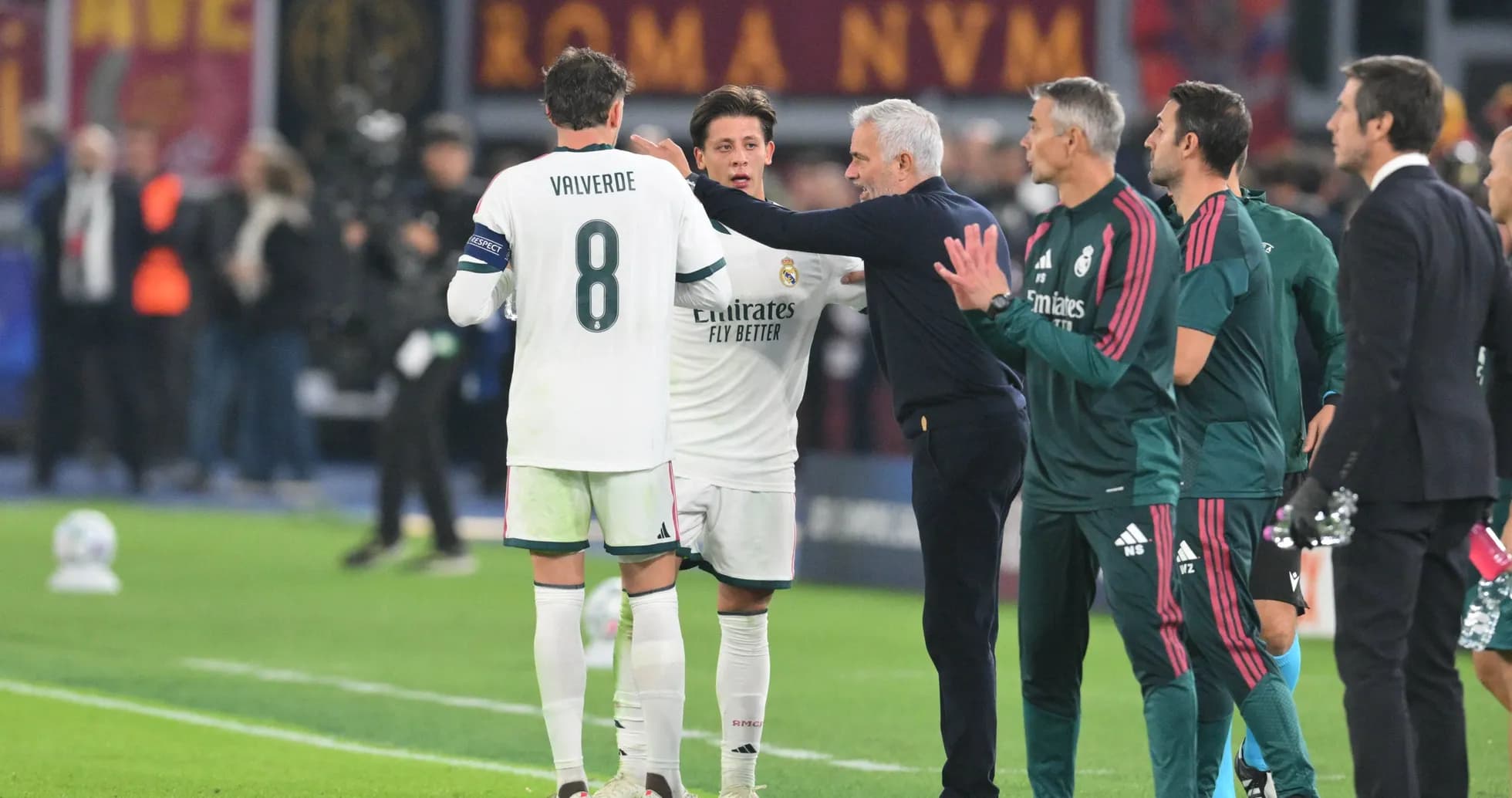
Reality has moved quickly. Despite the warm words José Mourinho offered at Real Madrid’s training complex – “He is an excellent professional, a friend to his team-mates, and although he is not a voice heard every second, he is always present as a role model for everyone” – Valverde will start against Valencia not in midfield, but at right-back.
And not as a stopgap. As a weapon.
Mourinho, whose experience in the dugout is matched by his feel for the dressing room, has nudged Valverde into the role step by step. This is not the first time the Uruguayan has been asked to patrol the flank. It is, however, the first time he has embraced it this fully.
The context matters. Neither Trent Alexander-Arnold nor Denzel Dumfries has truly nailed down the position in Mourinho’s eyes. Alexander-Arnold did little wrong in Santander. Dumfries arrives on the back of a decisive assist against AEK. On paper, both have arguments. On the pitch, the coach sees something else: when Valverde plays at right-back, the rest of the team breathes easier and plays freer.
That is the detail Mourinho wants to squeeze.
The timing has helped. Physically, Valverde is in prime condition, and the switch has opened new channels for the entire squad. With him starting deep on the right, Madrid gain an extra card on the table, a player whose movements shape team-mates and pin opponents in ways that feel clear, logical, and hard to counter.
Sevilla: the first full audition
The first real glimpse of this new version came against Sevilla. On his first start at right-back, Valverde delivered the kind of performance that turns an experiment into a plan.
Six ball recoveries. Five duels won – more than any of his team-mates. Three interceptions, two clearances, one shot blocked. Numbers that underline something the eye already knew: he dominated his channel, and he did it with the same intensity and clarity he once brought to midfield.
From there, his level has held. The doubts he voiced in another time and another city now feel like they belong to a different player. In Almaty, under Xabi Alonso, he had brushed off talk of tension over being used at full-back, insisting: “I was not born to play at full-back.”
That line has aged quickly.
Mourinho, who once insisted Valverde would never play there for him, has rowed back with purpose. He recognised the error, saw the potential, and decided that a coach’s job is not to cling to declarations, but to exploit advantages. In Valverde, he found a lethal hybrid: a midfielder’s brain, a full-back’s engine, and a captain’s sense of duty.
A captain’s step, a coach’s message
Valverde himself has framed it as a collective act, not a personal sacrifice.
“When we all work together and move in the same direction, we become stronger. And as the team’s captain, I took the step everyone was waiting for from me, and I provide a role model for my team-mates,” he said, distilling the shift into something bigger than a chalkboard tweak.
For Mourinho, that attitude is gold. He has held Valverde up publicly as a standard of commitment, a living reminder that this project is not static, not fragile, and not about individual comfort. It moves. It adapts. It asks more from its leaders.
And it asks more again tonight.
At Mestalla, against a Valencia side that rarely grants anyone an easy evening, Fede Valverde will jog out not as the roaming midfielder of old, but as the right-back who has redrawn Madrid’s balance. From there, with the touchline under his boots and the game ahead of him, he will try to prove that this reinvention is not a stopgap, but the next stage of his career.