Fantasy Basketball Forward Risers and Sleepers for 2026-27
The forward pool in Yahoo Fantasy High Score has been turned upside down. LeBron James is out of Los Angeles. Giannis Antetokounmpo has changed coasts and conferences. Rotations have been ripped open, and in those gaps, fantasy value is just sitting there.
High Score only cares about your best game of the week. It rewards stocks (steals and blocks) heavily. It doesn’t pay extra for threes. In this format, opportunity plus defensive juice is everything.
This 2026-27 forward class has plenty of both.
Forward Risers
Naz Reid, Charlotte Hornets
Naz Reid has been waiting for this.
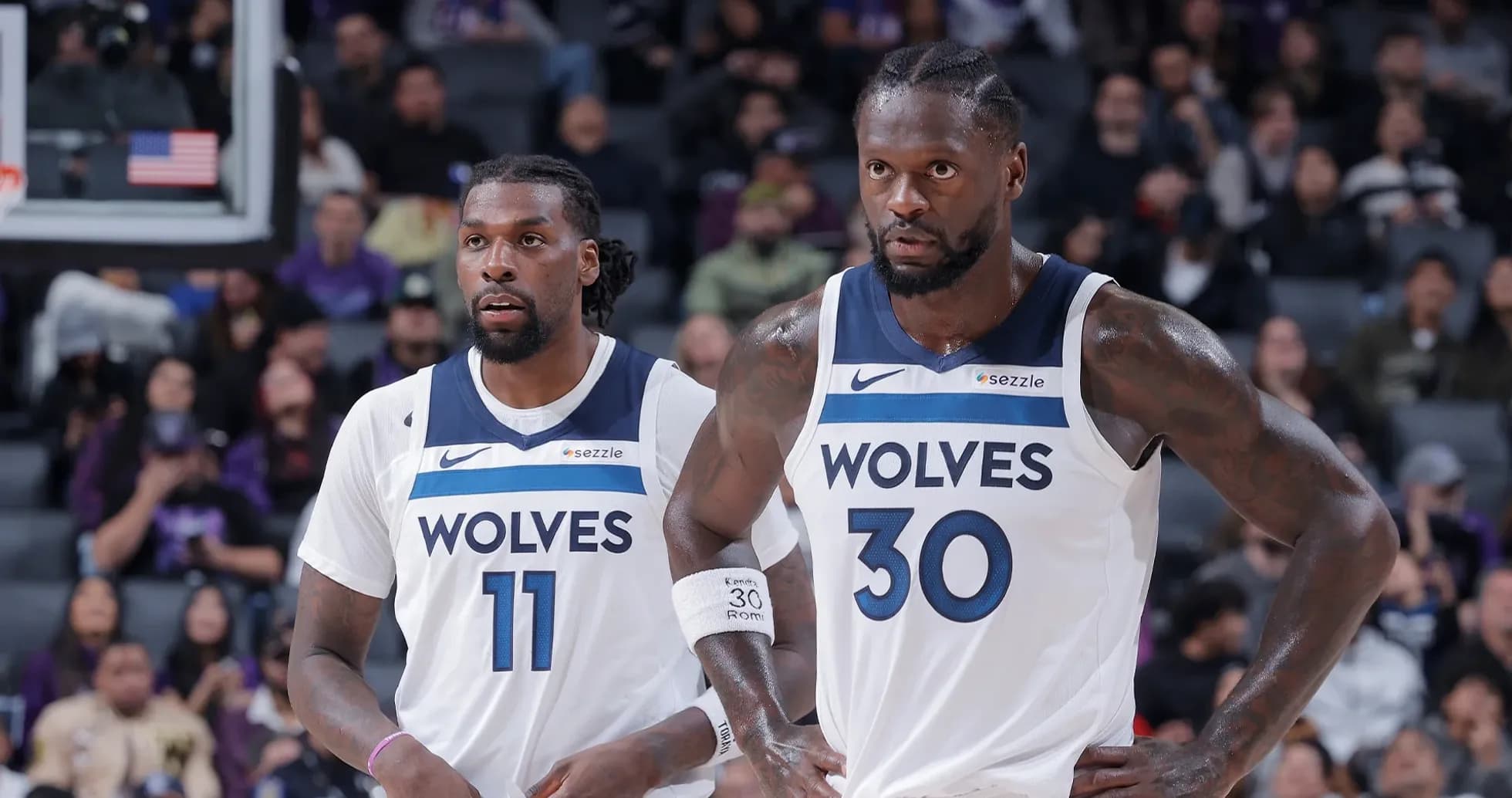
In Minnesota, he got paid but never fully unleashed, stuck behind Rudy Gobert and Julius Randle, living in that 20–26 minute range. He still produced: 13.6 points, 6.2 rebounds, 2.2 assists in 26 minutes last season. Never more than 28 minutes per game in any year.
Charlotte changes the story.
The Hornets went hunting for size this summer and lost Miles Bridges’ shot volume in the process. That’s not a subtle hint — it’s a runway. Reid walks into a realistic shot at 30-plus minutes for the first time in his career and a clear bump in usage.
We’ve already seen the outline of that player. Across 77 career starts, Reid has averaged 15.5 points, 7.1 boards, 2.0 assists, 1.8 threes, 1.1 steals and 1.2 blocks. That line sits at roughly 33.5 High Score points per game, and that’s before you factor in the extra minutes and touches that Charlotte can offer.
The key: those steals and blocks. High Score loves bigs who do a bit of everything, and Reid’s stretch-big profile gives him legitimate 40-point spike-game potential when the shot is falling. With an ADP of 65 on Yahoo, he’s being drafted like a solid starter.
He has the role and stat profile to finish like a problem.
Julius Randle, Brooklyn Nets
Minnesota didn’t just move Reid. Julius Randle is out as well, and Brooklyn is betting he can still be a centerpiece.
The Nets are retooling around Michael Porter Jr., with rookie guard Mikel Brown Jr. and a wave of youth around them. That leaves a familiar lane for Randle: high-usage, high-volume, everything-runs-through-him offense.
We’ve seen this movie. In 2022-23 with the Knicks, Randle averaged 25.1 points, 10 rebounds and 4.1 assists on a massive 29.5% usage rate. In Minnesota, he never got above 26.5% usage. That New York season translates to about 43 High Score points per night before you even add steals and blocks.
In a format where only your best game counts, that kind of ceiling is gold. A 30-15-6 night from Randle is not a fantasy. It’s a week-winner.
Brooklyn will need him to be aggressive. Fantasy managers should want the exact same thing.
Andrew Wiggins, Miami Heat
Miami changed everything when it landed Antetokounmpo.
Tyler Herro and a chunk of the Heat’s young core went to Milwaukee, leaving a roster that now orbits Giannis and Bam Adebayo. Davion Mitchell brings structure as a passer and defender. Tim Hardaway Jr. and Klay Thompson stretch the floor.
And in the middle of it, a wide-open lane for Andrew Wiggins.
Miami doesn’t need Wiggins to be a savior. It needs him to be a forceful third option. Even on a modest 19.4% usage rate last season, he posted 15.4 points, 4.8 rebounds, 2.7 assists, 1.1 steals and 1.0 blocks — roughly 32 High Score points a night.
That defensive line is sneaky. Those 1.1 steals and 1.0 blocks quietly stack value in this scoring system.
Historically, Wiggins has lived above that usage mark. He’d cleared 20.9% in every prior season, and at 24.5% two years ago, he averaged 18 points per game. Slide that version of Wiggins into a Giannis-led Miami team that needs his slashing and secondary scoring, and his current ADP of 110 looks light.
If he settles in as the clear third scorer, he’ll outplay that number.
Forward Sleepers
Jaime Jaquez Jr., Milwaukee Bucks
Jaime Jaquez Jr. has already ridden the NBA roller coaster once.
Promising rookie year. Dip as a sophomore. Then a bounce-back last season that re-established his trajectory.
He averaged 15.4 points, 5.0 rebounds and 4.7 assists in 28 minutes, while shooting 50.7% from the field — a sharp jump from 46.1%. That growth made him a centerpiece in the package Milwaukee demanded for Giannis.
Now the Bucks enter a new era. Tyler Herro steps in as the primary scorer. Ryan Rollins joins the backcourt. Kevin Porter Jr., Kyle Kuzma and Myles Turner round out a rotation that also features young pieces like Brayden Burries and Nate Ament.
In that mix, Jaquez looks like the adult in the room. A stabilizer. Someone who can log heavy minutes, move the ball and fill the gaps between scorers.
For High Score, his passing alone is a quiet weapon: 4.7 assists translate to 9.4 points in this format. He doesn’t rely on threes, and in a game where three-point volume carries no bonus, that’s no penalty at all.
With more touches available and a franchise that clearly values him, Jaquez is in position to set career highs across points, rebounds and assists. The role screams “safe floor.” The upside comes if Milwaukee leans on him even more as the season wears on.
Collin Murray-Boyles, Toronto Raptors
On paper, Collin Murray-Boyles sits behind a locked-in starter.
Jakob Poeltl is under contract through 2029-30 at more than $27.3 million per year. Toronto will open the season with Poeltl ahead of Murray-Boyles. That part is straightforward.
What isn’t so straightforward is Poeltl’s availability.
He played just 46 games last season and has appeared in 57 or fewer in each of his three full campaigns with the Raptors. Every missed night opens a door, and Murray-Boyles walked straight through it last season.
Across 22 starts, the rookie averaged 9.1 points, 5.7 rebounds, 2.7 assists, 1.1 steals and 1.2 blocks. That profile comes out to roughly 27 High Score points per game, with about a quarter of that total coming from steals and blocks alone.
That’s the exact defensive activity this format rewards.
There’s more. Sandro Mamukelashvili’s 22 minutes per game are now gone to Los Angeles, freeing up even more frontcourt time. At an ADP of 122, Murray-Boyles doesn’t need 32 minutes to pay off. He just needs his usual energy and a path to 22–26 minutes when the rotation tightens or injuries hit.
If Poeltl misses time again, Murray-Boyles becomes one of the most valuable plug-and-play forwards on the board.
Sandro Mamukelashvili, Los Angeles Lakers
Sandro Mamukelashvili finally got a real role last season. He didn’t waste it.
Before Toronto, he’d never topped 15.3 minutes per game. The Raptors trusted him with 22 minutes a night across 80 games, and he responded with 11.2 points and 4.9 rebounds while shooting 52.3% from the field and 38.9% from three.
That tape got the Lakers’ attention.
Los Angeles needed size and shooting. It handed Mamukelashvili a four-year, $52 million deal and, with LeBron James no longer in town, opened up real power forward minutes. He’ll battle Jake LaRavia and others, but another career high in playing time is firmly in play.
There is one twist for High Score managers: three-point shooting doesn’t have its own category. Mamukelashvili’s value comes from the rebounds and any defensive stats that ride along with his expanded role, not from his range alone.
At an ADP of 114, he doesn’t require a massive leap to justify the pick. If the minutes climb and the counting stats follow, he becomes exactly what you want in the later rounds — a steady, multi-category forward in a marquee market with room to grow.
The stars have moved. The rotations have shifted. For managers willing to lean into change, these forwards are where the season’s edges will be found.