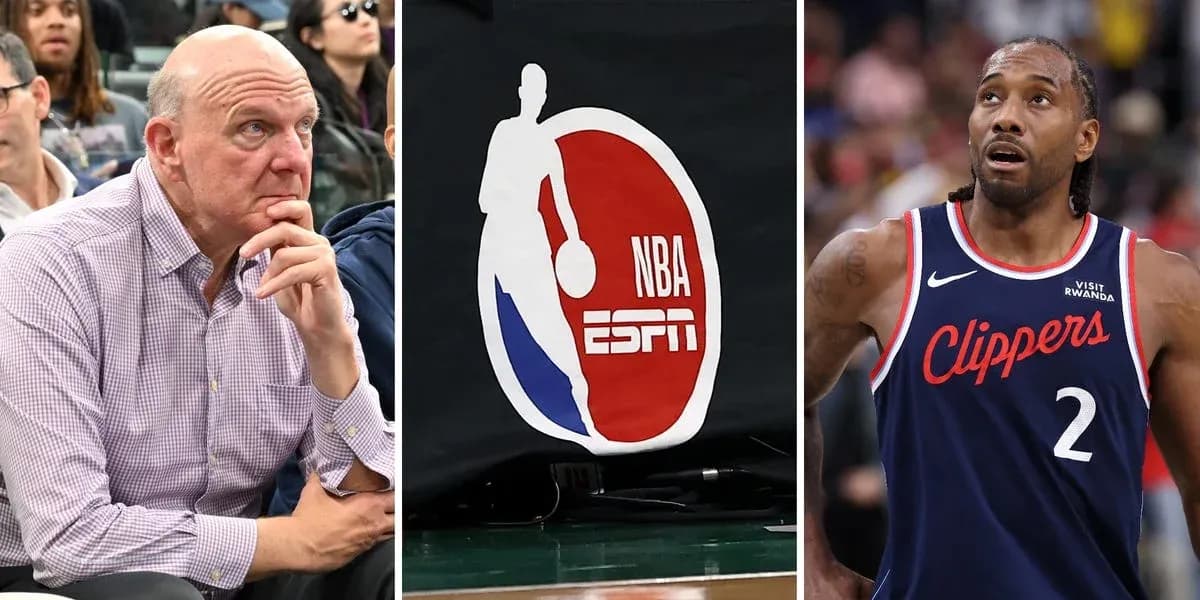
ESPN’s Credibility Crisis: The NBA's Ruling on the Clippers
The NBA’s hammer blow to the Los Angeles Clippers has landed squarely on ESPN’s doorstep.
What began as a salary-cap scandal in LA has turned into a credibility test for the self-proclaimed Worldwide Leader in Sports, after the league’s landmark ruling exposed a glaring gap between ESPN’s early reporting and the NBA’s final judgment.
A Narrative Split in Two
On August 17, ESPN published a story built around three unnamed sources who insisted the NBA had “no evidence” that Clippers owner Steve Ballmer funneled money through team sponsors to pay Kawhi Leonard. One anonymous source went even further, dismissing the idea that sponsorship introductions could count as cap circumvention as “dead on arrival.”
That framing did more than just offer a prediction. It set up a clash.
On one side: ESPN, leaning on league and team-adjacent voices to suggest the Clippers would skate by. On the other: Pablo Torre, the former ESPN journalist whose Pulitzer-winning investigation detailed Leonard’s ties to Clippers sponsors and raised sharp questions about how those deals were arranged.
Online, the storyline crystallized quickly: “ESPN vs Pablo.”
When the NBA finally spoke, the league chose a side — and it wasn’t ESPN’s.
The Ruling That Changed Everything
After a nearly yearlong investigation, the NBA announced Wednesday that it had found the Clippers and Ballmer in violation of league rules by facilitating sponsorship deals with Leonard. Commissioner Adam Silver hit the franchise with a $30 million fine, docked Leonard $700,000, and suspended Ballmer from league activities for a year.
It was the harshest penalty of its kind. Exactly the kind of “severe” outcome ESPN’s August reporting had strongly implied was unlikely.
The Clippers fired back in a statement, saying they “vehemently reject the NBA’s findings,” calling the probe “the result of a heavily biased investigation.” Leonard, in his own statement, struck a different note, saying he accepted “full responsibility for lapses in judgment by people within my inner circle.”
For Torre, the league’s decision effectively validated his reporting and the way he had framed the story from the start. For ESPN, it opened a different kind of investigation — one playing out in public.
ESPN Under the Microscope
ESPN has not issued corrections to its August story. On paper, some of the language may survive a legalistic read. But public relations experts say the problem runs deeper than technical accuracy.
“While it might be accurate in the wording, the substance of the story was very misleading,” said Brian McWilliams, VP at LA-based firm Spelling Communications.
That “substance” is what now threatens ESPN’s relationship with its audience. The network has staked its future on direct-to-consumer streaming and constant engagement on social platforms. That model only works if fans believe the coverage isn’t softened for powerful leagues or billionaire owners.
McWilliams warned the sports giant could “risk a lot of damage to the brand,” pointing out that fans now see an outcome “starkly in contrast with ESPN’s reporting.”
That contrast has become the story.
“The audience just needs an explanation,” said New York-based brand and communications consultant Sam Gauchier.
So far, they haven’t received one. An ESPN spokesperson said the company stands by its mid-August Clippers story and declined to comment further.
A PR Storm of ESPN’s Own Making
The trouble didn’t stop with the original article.
ESPN reported in August that the NBA did not respond before publication. After the story went live, NBA spokesman Mike Bass publicly blasted it, saying on social media that it contained “numerous and significant inaccuracies,” and promising those would be exposed once the investigation wrapped.
The eventual ruling did exactly that in the court of public opinion.
Compounding the tension, the ESPN piece that seemed to undercut Torre’s work quoted from his findings but did not include a statement from him. Torre said Thursday that he had provided ESPN with a comment affirming he stood by his reporting and was eager to see the NBA’s findings. He said ESPN chose not to publish it.
That editorial decision now looks pivotal. What might have been framed as a legitimate disagreement in interpretation instead appeared, to many, as ESPN sidelining a journalist whose work ultimately proved prescient.
For Bradley Akubuiro, a partner at PR firm Bully Pulpit International, the challenge now is not just about fact-checking. ESPN’s PR team, he said, must persuade the public that the company’s reporting reflects “not only the technical accuracies, but the overall expectation of truth that their readers have.”
The stakes are clear: fans are less interested in whether a sentence holds up under legal scrutiny than whether the overall picture matches reality.
The Access Dilemma
The fallout spread again when Shams Charania, one of ESPN’s top NBA newsbreakers, weighed in on TV on Thursday. Charania said Leonard “did not have any knowledge” of the salary-cap circumvention — then, in the same segment, noted that Leonard “pocketed tens of millions of dollars” from Clippers sponsors.
That juxtaposition drew instant scrutiny. Torre responded on X, posting a screenshot of Leonard’s signature on a purported contract with former Clippers sponsor Aspiration Partners, sharpening the focus on what players know, what they sign, and what insiders choose to say on air.
McWilliams pointed to the inherent tension for reporters like Charania, who live on scoops and access.
They walk “a very fine line between wanting to be first, wanting to be accurate, and also wanting to maintain access, which can be revoked,” he said.
That fine line is where ESPN now finds itself. Not on the court, but in the space between the leagues it depends on and the audience it claims to serve.
The NBA has delivered its verdict on the Clippers. The next judgment — on ESPN’s handling of the story and the balance it strikes between access and accountability — will come from viewers.