Eddie Howe: The Next Manchester United Manager?
When Sir Jim Ratcliffe bought into Manchester United in early 2024, he sold a clear idea: a rebuilt club with a strong British spine, from the dressing room to the dugout. Less than two years on, that vision already feels under strain.
Michael Carrick, the first permanent British managerial appointment of the Ineos era, is fighting to keep his job. Performances have dipped, results have followed, and the sense of drift has returned. Ratcliffe may be re-examining what a “British core” really costs — in transfer fees, in patience, and in political capital with a restless fanbase.
Yet if Carrick cannot halt the slide, United are not about to abandon the British route entirely. They are looking again at a homegrown coach. This time, one with scars and silverware.
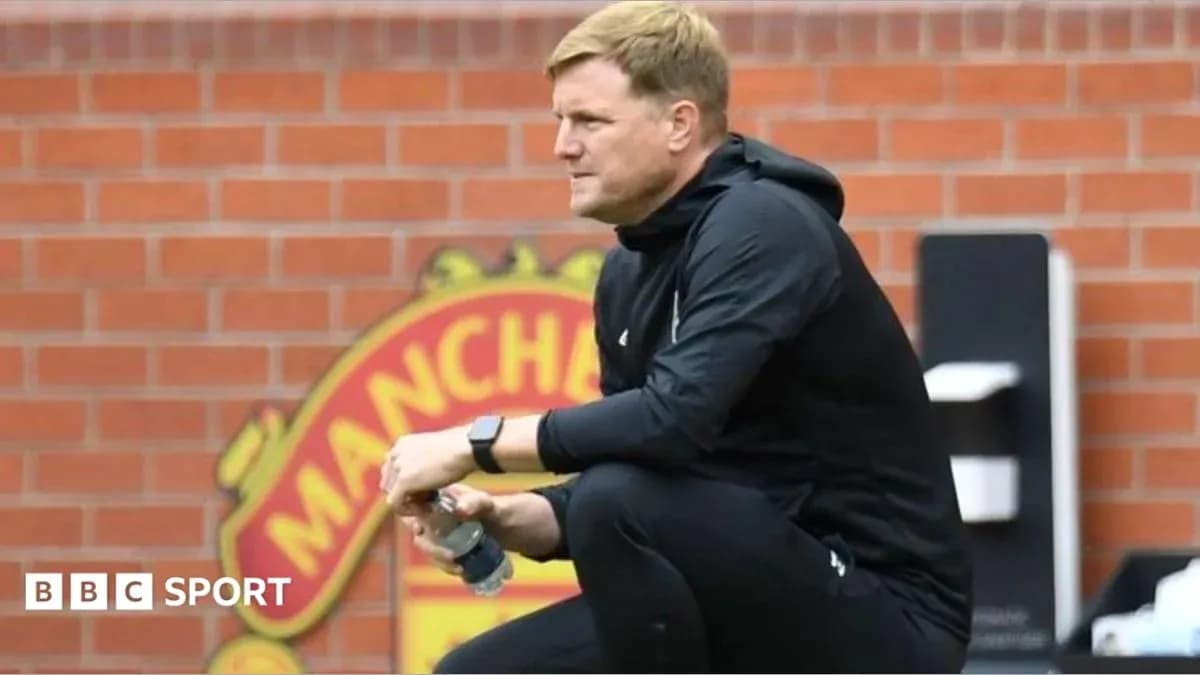
They are looking at Eddie Howe.
Howe’s body of work
Howe’s name on a Manchester United shortlist is no mystery to anyone who has watched his rise closely. Colleagues and players talk about an obsessive on the training ground, a coach who drills and re-drills until habits change and standards rise. The improvement in individuals, they say, is no accident. It comes from repetition, detail, and a clear idea of what a winning environment should look like.
He does not come with the glamour of a serial Champions League winner or a coach already blooded at a traditional “big six” powerhouse. What he does bring is a body of work that few British managers of his generation can match.
In January 2009, Bournemouth were staring at relegation from League Two when Howe took over. By 2015, he had them in the Premier League. Not just visiting, either. He kept them there, established them as a top-flight club, then left in 2020 having reshaped the very notion of what Bournemouth could be.
Newcastle was another rescue act. Appointed in 2021 with the club in serious trouble, he hauled them away from the drop zone and into the Champions League — twice. In 2025, he delivered the EFL Cup, Newcastle’s first trophy in 56 years. For a fanbase used to waiting, he finally put something tangible in the cabinet.
That track record makes him an obvious candidate for any elite job that opens up, whether at Old Trafford or with England. But United is not Newcastle. It is not Bournemouth. It is a club that eats managers and shrugs.
The Old Trafford question
The moment Howe’s name surfaced as a potential successor to Carrick, the reaction was sharp. And split.
On social media, sections of the United fanbase dismissed him as too small a name for a club that still sees itself as a global superpower, even if the league table often suggests otherwise. For some, the badge demands a coach with instant star wattage, not another builder.
Former United players have not exactly united behind him either. Paul Scholes and Nicky Butt, speaking on their podcast, stopped short of offering full backing. Their tone was cautious, their endorsement partial. Yet it is worth remembering they spoke positively about Howe when Ruben Amorim was sacked in January, arguing then that the 48-year-old would be a strong candidate.
Others have been more emphatic. Roy Keane, never one to hand out praise lightly, has publicly backed Howe as a credible successor. Darren Bent, Gareth Barry and Jack Wilshere have also pushed his credentials, arguing his work at Bournemouth and Newcastle should carry more weight than the absence of a previous “super-club” on his CV.
Strip away the noise and it comes down to a familiar reality: every candidate has advocates and critics. United’s decision-makers will have to cut through the emotion and decide what they want this club to be.
Power, politics and a seven-figure call
Inside Old Trafford, the key figures are already weighing it up. Chief executive Omar Berrada, sporting director Jason Wilcox and director of recruitment Christopher Vivell will shape the recommendation that eventually lands on the desks of Ratcliffe and co-chairs Joel and Avram Glazer.
Their first call is not about Howe. It is about Carrick. Saturday’s game against Chelsea looms large. A result, a performance, even the mood inside the stadium could tilt the internal debate. If Carrick survives, the discussion pauses. If he goes, the search accelerates.
Money will matter. It always does at United these days, not because they are poor, but because they have already spent so much on the churn of managers and their backroom teams. Any sacking brings a bill. Carrick and his staff will need to be paid off before the club even turn to the cost of the next head coach.
Howe is not technically a free agent in the way many assume. When he left Newcastle in the summer, the club protected themselves. Multiple sources have indicated to BBC Sport that a compensation structure was agreed to prevent him walking straight into another job without a return for the Magpies.
That deal, understood to have started at £6m, decreases over time. The figure has already been cut in half. Right now, any club or national team wanting Howe would need to pay a seven-figure fee, around £3m, to Newcastle. The clause has an expiry date believed to be before the end of the season. After that, he can be appointed without compensation.
In an era of £100m transfers, £3m for a head coach is not an outrageous number. But for a club that has burned through money on managerial changes, it is still a line on a balance sheet Berrada and Wilcox cannot ignore. Ratcliffe, too, has spoken about discipline and structure. That extends to the dugout.
Divided vision at the top
Inside United’s new football structure, there is no single, unanimous vision. There rarely is at a club this size.
Jason Wilcox is understood to favour Howe. He sees a coach aligned with the idea of building, improving, and establishing a clear identity over time. Christopher Vivell, by contrast, is thought to lean towards Julian Nagelsmann, the former Bayern Munich and Germany coach, whose reputation rests on tactical innovation and work in high-pressure environments.
Their views will be filtered and tested by Berrada. Above them sit Ratcliffe and the Glazers, who retain the final say. The choice between Howe and a name like Nagelsmann is not just about tactics or profile. It is a statement of direction. British builder or continental strategist. Incremental growth or big-bang appointment.
The hostility towards Howe in some quarters is hard to pin down beyond that wider disillusionment. Wilcox was targeted by fans during the 3-0 home defeat by Bournemouth, a night that crystallised frustration with the club’s football decisions since Ratcliffe arrived. Ten Hag was backed. Amorim was backed. Carrick was backed. None has yet managed to knit this sprawling squad into a coherent, enduring force.
A club still searching itself
There is a deeper, more uncomfortable argument bubbling beneath the surface: that no manager can truly succeed at Manchester United with the current structure. Six permanent managers have shaped this squad, each with different ideas, different profiles of player, different rhythms of play. The result is a dressing room built in pieces, not as a whole.
Whoever stands in the technical area has to mould that into something consistent. That challenge will not disappear with a new name on the office door.
This is the context into which Eddie Howe is being invited, at least in theory. A coach who has thrived when given time and trust, asked now to step into a club where both commodities have been in short supply.
If United offer him the job, it will say plenty about where Ratcliffe and his new regime believe the future lies. If they look elsewhere, it will be an equally clear message.
Is Old Trafford ready to back a builder again, or still chasing the shortcut it has never quite found?