The Complexity of Awarding All-Stars in GAA
Whose fault was that score? Anyone’s?
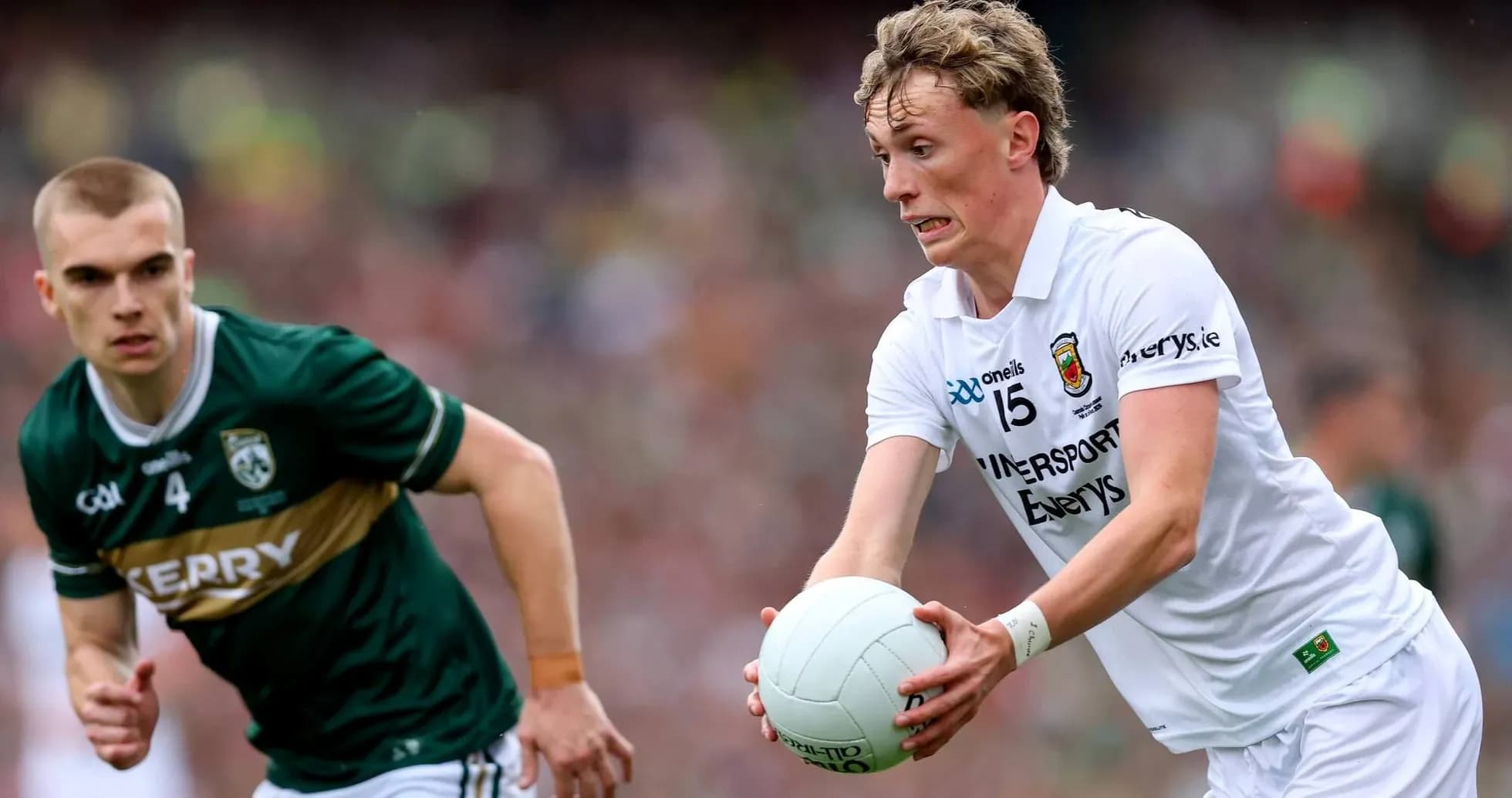
Kobe McDonald had done everything right, at least until the line appeared beneath his boots. He was glued to David Casey as the Kerry man burst from deep, shadowing him stride for stride. Then he hit halfway and slammed on the brakes, like Wile E Coyote at the canyon edge, because the system said: do not breach.
Just ahead, Eoin McGreal hovered, body turned away from the ball, eyes locked on Paudie Clifford. The danger he knew, not the danger arriving.
Jordan Flynn picked up Casey’s run when the handpass came, then peeled off in search of the ball as soon as Casey laid it off. Casey never stopped. Clifford found him again. Kerry’s opening point.
So whose man was it, really? Should a Mayo teammate have dropped back to free McDonald to keep tracking Casey? Should one of the other man-markers have slid across to the ball-carrier? Should Flynn have stayed with Casey once he’d taken him on?
And if you’re arguing about that one play, what does it say about how we hand out All-Stars?
The illusion of the clean answer
This is where individual awards in a team game always fall apart. They pretend to be definitive. They are not. They are judgement, not equation.
Every year the same suggestions come around. Let current players and managers have more say. Bring in more data. Put extra weight on league form or the early rounds of the championship. Everyone is hunting the same thing: the magic fix.
Players want the one tweak that nudges them into a starting 15 or onto an awards shortlist. Managers search for the one change that makes this season the year. Journalists go looking for the one neat line that explains why one team climbed the steps and another watched.
It is never one thing.
Games, seasons, careers – none of them turn on a single component. Simple stories are comforting. The reality is chaos: a mind-bending number of small moments, roles, and responsibilities feeding into every decision. Any selection panel that pretends otherwise is kidding itself.
There is no perfect system.
What the numbers see – and what they miss
Part of the problem is how the sport is measured. GAA data is stacked towards possession. Kickout wins. Scores. Shots. Assists. All the bright, shiny, on-the-ball stuff.
Those numbers matter. They should shape the debate. But they live in a world without context unless you drag that context in with them.
Take Mayo’s 2026 championship. Their leading assisters? A three-way tie: Ryan O’Donoghue, Kobe McDonald and Jack Carney. Next on the list: Sam Callinan, from corner-back, with a total of 13 points created. He also scored with the only two shots he took all summer.
How much weight does that carry for a defender nominally picked to shut down, not to create?
There are off-ball metrics. Tackles. Turnovers won. Some inter-county setups log “breaches”, charting every time a defender is beaten by man or by ball. Those figures are slow to collect, harder to explain and, bluntly, less glamorous. They don’t fit neatly into a graphic or a headline.
Then there are the matchups. The whispers and boasts that follow a marker around.
How often have you heard it said that Jack Coyne held his direct opponent scoreless from play in his last four games? It’s the kind of stat that grows legs.
Look at the All-Ireland final. Coyne started on Dylan Geaney, with McGreal picking up Paudie Clifford. By midway through the second half, both McGreal and Geaney were gone and Coyne had been switched onto Clifford.
Kerry’s last point of the day told its own story. Clifford took the ball outside the arc, squared up Coyne, shimmied twice and slipped past on the left to score. One moment, one duel, one score. It doesn’t erase Coyne’s season. It doesn’t mean he didn’t deserve recognition. It does force you to prod at that tidy “held scoreless” line and see what spills out.
Defenders in an attacker’s game
Modern football has tilted heavily towards the attacker. Rules, conditioning, systems – the game wants scores. Defenders bend and bend again. Their job is no longer simply to “stop your man”. Sometimes they must call a switch. Sometimes they sag into space. Sometimes they track a decoy runner so someone else can step into the line.
Those decisions rarely look clean on a spreadsheet.
David McBrien is a case study. He struggled at midfield against Roscommon. Bobby McCaul caused him real issues for Monaghan. Louth’s Ciaran Downey clipped 0-4 directly off him. On paper, those are black marks.
Yet so much of McBrien’s brief sits inside a collective structure: doubling up, dropping into the hole, offering sweeper protection. In the All-Ireland decider he was a legitimate contender for Player of the Match. How do you reconcile that with the earlier bruises on his record?
You can’t, if you only stare at raw concession tallies.
Then there’s Matthew Whittaker, who spent much of the year playing through injury. How do you fold that reality into a voting sheet? Or Jordan Flynn, working like a piston in a centrefield that was, at times, under siege. The numbers will log his possessions and scores. They won’t capture the sheer graft that kept Mayo afloat in long, grim passages.
On the other side of the ball, Paudie Clifford played eight championship games. His Croke Park return across the final three? 0-13, with 0-9 from play. Elite numbers, delivered when the stakes were highest. Earlier in the summer, against Cork, Donegal and Armagh, his influence was blunted by various impediments.
So what carries more weight: the body of work, or the explosion on the biggest stage?
These are not academic questions. They’re the arguments that shape who walks into the All-Stars banquet with a medal in the pocket of the suit jacket and who doesn’t.
Tinkering with an imperfect machine
No one is saying the process can’t get better.
For the Tailteann Cup Team of the Year, players and management already submit their own selections to guide the final call. That kind of internal feedback could easily be extended. A formal stock-take during the championship could stop early-round excellence from evaporating by September.
Sponsors could go further again. Commission an independent analysis firm such as GAA Insights to produce a comprehensive data report. Hand it to selectors. Build campaigns around it. Let it fuel the arguments in living rooms and club bars long after the official team drops.
Because that’s what this really is: an argument. A structured, informed, occasionally heated argument about individual tallies, collective duties, injury histories, defining moments, form, fitness and all the intangibles that cling to a season.
There is no clean answer. There never will be.
Pretending otherwise doesn’t just simplify the game. It sells the players, and the complexity of what they do, short.