Battle for the 2030 World Cup Final: Political Tensions Rise
The battle for the 2030 World Cup final has already started – and it is being fought in political halls as much as in football boardrooms.
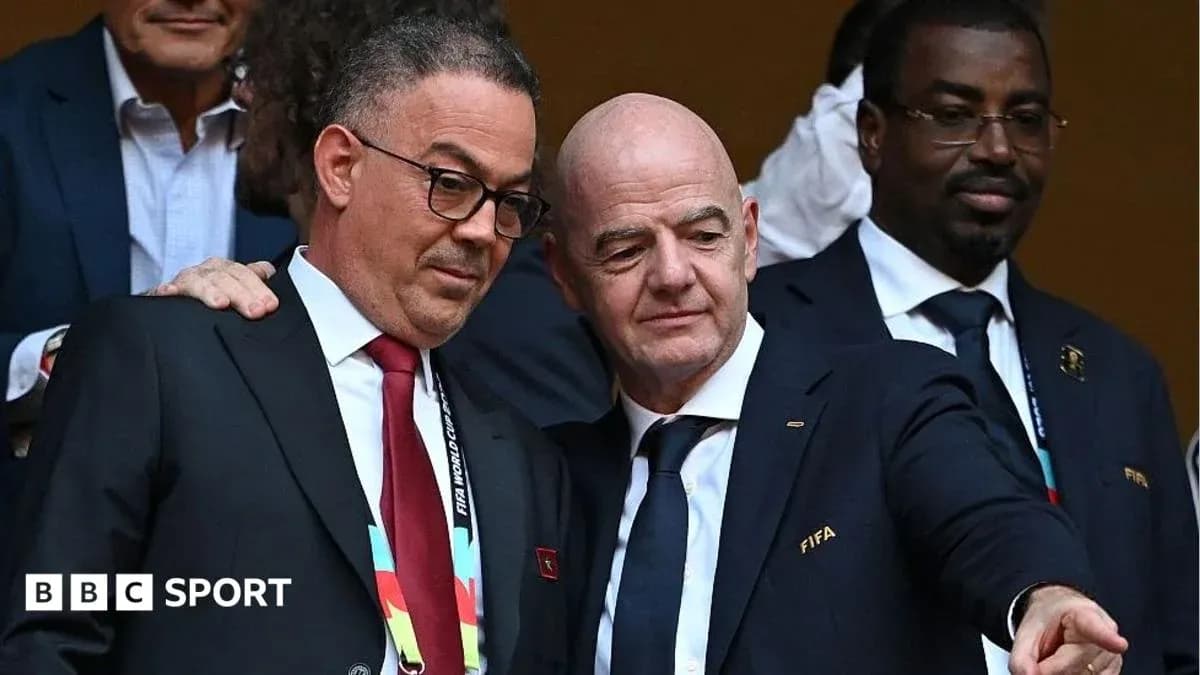
Morocco’s prime minister Aziz Akhannouch has publicly rebuked Fouzi Lekjaa, the powerful president of the Moroccan football federation (RMFF), telling him to stop promising that Casablanca will host the showpiece game of the tournament shared with Spain and Portugal.
The message was blunt. The timing, pointed.
Political warning in Casablanca
Speaking at a rally, Akhannouch addressed Lekjaa directly after the federation chief had told a political party event that Casablanca would have the “honour” of staging the final.
“Do not offer to host the big final game in Morocco while we still have not discussed the matter with our allies, Spain and Portugal,” the prime minister said.
Then came the sharper line.
“There should be some respect, brothers. Stop using electoral promises to pull the rug out from under us. These are huge matters. Deciding where the final will be held is a major issue.”
In other words: the World Cup final is not a campaign slogan.
The intervention exposes the tension beneath a bid that was sold as a model of cross-continental unity. The 2030 tournament will be co-hosted by Morocco, Spain and Portugal, with the opening three matches sent across the Atlantic to Uruguay, Argentina and Paraguay in a nod to the World Cup’s centenary. But unity has limits when the biggest match in football is on the table.
Spain stakes its claim
Spain has never hidden its ambition to land the final. Rafael Louzan, president of the Spanish football federation (RFEF), has already gone on record insisting the showpiece should be played on Spanish soil.
“Even though no decision has been taken, I believe Spain is the place because it cannot be any other way,” he told Cadena SER. “As you know, we are currently world champions.
“I believe Spain's organisational capacity for major events is beyond question and that is why reality dictates that the grand final cannot and must not be held anywhere other than in Spain.”
Louzan is leaning hard on recent success. Spain’s men lifted the World Cup for the second time this summer, strengthening the RFEF’s belief that the country sits at the centre of the global game once again. From their side, the logic is simple: champions, infrastructure, history – and a proven track record of hosting major events.
The pressure is being applied in public, and deliberately so.
Fifa keeps its distance
For now, Fifa is keeping everyone at arm’s length.
World football’s governing body has confirmed only that a list of host stadiums has been proposed and that the final decision – including where the final itself will be played – “will be made in due course”.
That phrase leaves ample room for manoeuvre, and plenty of time for political lobbying. In 2026, New Jersey’s MetLife Stadium was only confirmed as the host for the final in February 2024, two years before the tournament began. The pattern is clear: Fifa likes leverage, and the later the call, the greater the leverage.
Stadiums as statements of power
Behind the diplomatic language lies a very physical race: concrete, steel and capacity.
Morocco is building a proposed 115,000-seat stadium, which would become the largest football arena in the world. It is a bold project, a statement of intent from a country that has long courted the World Cup and now finally has its share of one.
Across the Mediterranean, Spain counters with pedigree and polish. Real Madrid’s Santiago Bernabeu has been dramatically modernised and now holds 83,000, a gleaming, multi-purpose arena in the heart of the capital. Barcelona’s Spotify Camp Nou, once its renovation is complete, will host 105,000, restoring its status as one of the game’s great cathedrals.
These are not just venues. They are arguments.
Capacity, location, transport, commercial pull – every factor will be weighed. A 115,000-seat stadium in Morocco carries immense symbolism for African football. A final in Madrid or Barcelona would sit comfortably inside the traditional power corridors of European football.
Allies, rivals, co-hosts
The joint bid was sold on partnership, but the past few days have underlined a harsher reality: allies can be rivals when the biggest prize is involved.
Akhannouch’s warning to Lekjaa was not just about protocol. It was about keeping Morocco’s relationship with Spain and Portugal intact while the three countries negotiate with Fifa from a united front. Public promises risk looking like unilateral moves, and that is precisely what the prime minister moved to shut down.
Spain, for its part, has no intention of softening its stance. Louzan’s words were carefully chosen but left little room for doubt. The RFEF sees the final as theirs to lose.
The stadium list is not yet finalised. The politics are only just warming up. Somewhere in Zurich, Fifa will be watching as three hosts, bound together on paper, jostle for the right to stage the one match that defines a generation.
The 2030 World Cup was meant to celebrate 100 years of history. It may also reveal who really holds the future.