Barcelona's Youngest Starting XI in History at Spotify Camp Nou
At the Spotify Camp Nou, history did not just stir. It kicked the door down.
Hansi Flick, barely months into his Barcelona tenure, sent out a team so young it rewrote the club’s record books. The average age of his starting XI: 23.18 years. No Barça side had ever begun a home game with fewer birthdays behind it.
That number is not a curiosity. It toppled a benchmark that had stood for 14 years, one set by Pep Guardiola’s Barcelona in 2011, when he fielded his famously fresh-faced line-up against BATE Borisov in the Champions League. As journalist Oriol Domènech confirmed, Flick’s team now stands alone as the youngest Barça have ever started at the Camp Nou.
A La Masia spine, and a lone 20th-century man
Look down the team sheet and the theme is unmistakable. This is La Masia’s house.
Seven of the starters came through Barcelona’s academy. Two more, Pedri and Joan García, are Spanish internationals. Only Raphinha and Anthony Gordon were born outside Spain. For a club that has spent the last decade wrestling with its identity, this XI read like a manifesto.
The dates of birth tell the story even more starkly. Raphinha, born in 1996, stood alone as the only starter from the 20th century. Around him, the squad clustered into tight bands of youth: Joan García, Eric García and Anthony Gordon all born in 2001, Gerard Martín and Pedri in 2002, Fermín in 2003.
Then came the real jolt.
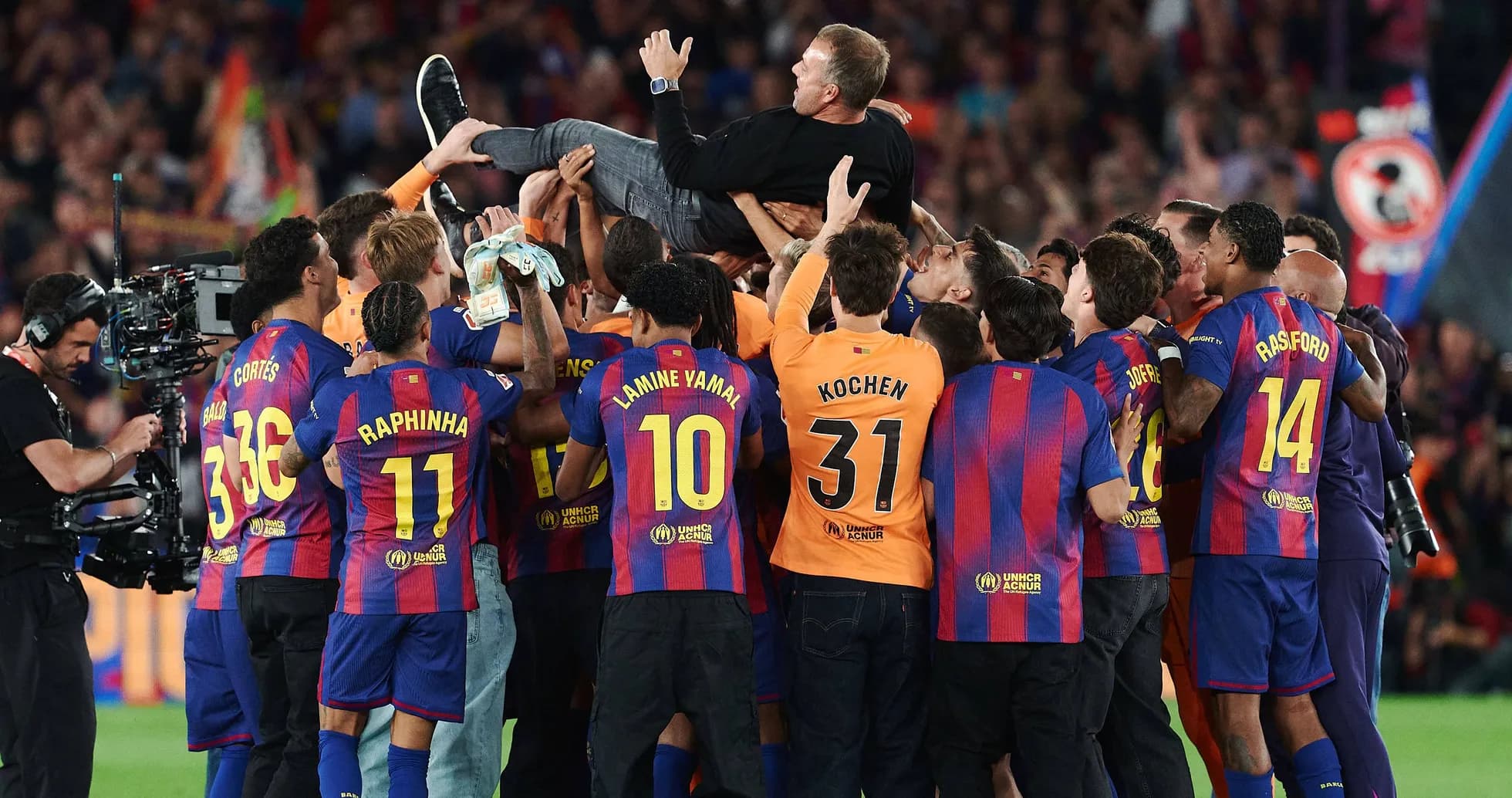
Flick did not just lean on teenagers; he threw in four players born in 2007 at the same time: Pau Cubarsí, Marc Bernal, Xavi Espart and Lamine Yamal. One is bold. Four is a statement. On a night of pressure and expectation, he trusted them all.
Deco’s blueprint made flesh
This was not a romantic one-off, a coach indulging in a sentimental nod to the academy. It is the visible edge of a wider plan shaped by sporting director Deco.
Barcelona currently own the youngest squad in La Liga, tied with Levante, with an average age of 24.2 years. Stretch the comparison across Europe’s top five leagues and they still sit among the continent’s freshest groups, ranking as the fifth youngest behind Auxerre (23.6), Parma (23.4), Toulouse (22.5) and Strasbourg (22).
Eleven players in this squad are under 20. Not prospects tucked away in the background, but footballers already hardened by elite minutes. Lamine Yamal, Cubarsí and Bernal all carry significant top-level experience despite none of them having turned 19.
The dressing room is not entirely a youth hostel. Five players are over 30: Szczęsny (36), Cancelo (32), Livaković (31), Christensen and Rodri (both 30). Three of those arrived this summer, handpicked to add calm and authority around the kids. Just below them sit Anthony Gordon (25) and Adeyemi (24), the “middle class” Deco has spoken about, the bridge between the veterans and the prodigies.
The balance is deliberate. The message is clear.
Flick steps out of Guardiola’s shadow
Any Barça coach who touches the record books inevitably brushes up against Guardiola. Flick has now nudged him aside in at least one column.
Back in December 2011, Guardiola made waves by starting five reserve-team players — Bartra, Rafinha, Cuenca, Montoya and Sergi Roberto — in a 4-0 win over BATE Borisov. That night became shorthand for his faith in La Masia and the club’s production line.
Flick has gone further. Younger, greener, and in greater numbers.
He did not just beat a record. He embraced the risk that comes with it, gambling that talent and bravery could outweigh inexperience on one of world football’s most demanding stages.
Barcelona have spent years talking about rebuilding, about returning to their roots, about trusting the academy again. On this night at the Spotify Camp Nou, under a coach unafraid to lean on teenagers and a sporting director intent on reshaping the squad’s DNA, those words finally looked like a project in motion.
The question now is not whether this was historic. It is how far this generation can carry the club before someone even younger comes along to break their record.