VfL Osnabrück's Unique Tifo: A Rollercoaster Ride
In a country that treats tifos like high art, VfL Osnabrück just ripped up the script.
Germany has given us Borussia Dortmund’s “Yellow Wall”, Bayern Munich’s vast choreographies at the Allianz Arena, and countless choreographed mosaics that turn stadiums into canvases. On Wednesday night at the Bremer Brücke, a freshly promoted second-division club produced something different. Something moving. Literally.
A Rollercoaster in the East Stand
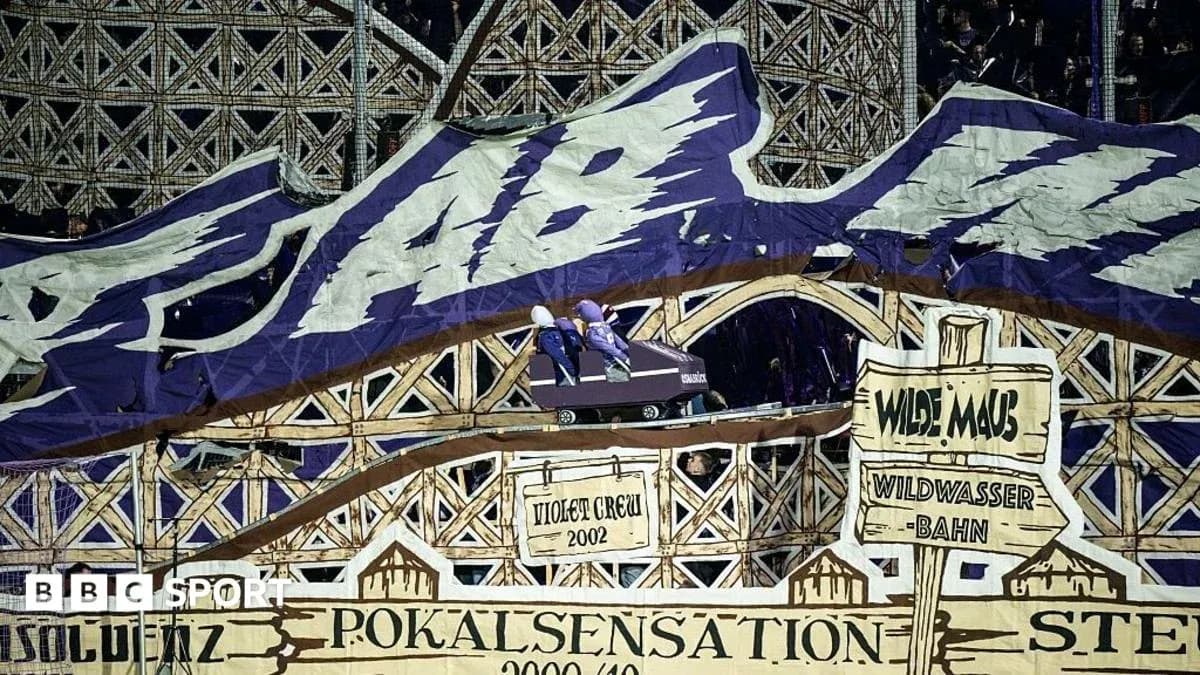
Ahead of their German Cup first-round tie against Bayern Munich – a game they would lose 4-1 – Osnabrück unveiled a tifo that turned the East Stand into an amusement park.
Across the stand, a huge banner declared: “VfL Osnabrück – a rollercoaster ride!” In front of it, a full rollercoaster track snaked along the touchline, built from wooden slats, plastic piping and fabric, assembled in sections so it could be rolled out and locked into place.
On that track sat a cart. Not a cardboard cut-out, not a painted illusion, but a constructed wagon, mainly wood and styrofoam, loaded with dummies in Osnabrück colours. As the teams prepared to kick off, the cart clattered into life, shuttling along the track, then getting hauled back to the start by a push-and-pull system so it could go again. And again. And again.
The Yellow Wall might roar louder. The Allianz might shine brighter. On this night, though, the most inventive stage in German football belonged to a club that has spent more time battling in the lower leagues than basking in the limelight.
A Club’s Turbulent Story, in Motion
Osnabrück framed the tifo as a symbol of their history: a “rollercoaster ride full of ups and downs”. Anyone who has followed the club knows that isn’t marketing spin. Promotions and relegations, financial worries, moments of delirium, and long spells of grind – it has rarely been smooth.
That journey ran through the display. Along the route of the track, fans picked out some of the club’s defining moments. There was the famous 1978 victory over Bayern Munich, a result still spoken about with a kind of disbelief in these parts. There were references to scandals, bitter defeats, and the kind of heartbreak that hardens a fanbase rather than breaks it.
This was not just a clever stunt. It was a living timeline, looping around in front of the East Stand as if to say: this is who we are, this is what we’ve been through, and we’re still here.
Months in the Making
None of it came together overnight. Osnabrück said the tifo took “several months” of planning and building. That shows in the engineering as much as the aesthetics.
The rollercoaster structure had to be light enough to move, strong enough to hold the cart, and flexible enough to be deployed in sections. The cart itself needed to look the part but still be functional, rolling smoothly along a track that was never designed for theme-park standards.
The result? A choreo that didn’t just rise when the players walked out and disappear when the whistle blew. It moved with the noise, the songs, the tension.
A Final Twist: The Photo Finish
Just when it seemed they had shown everything, there was one more detail.
As the cart rattled along its route, it passed a “photo station”. A flash fired. A moment later, the “photo” of that cart appeared on the right side of the grandstand, mimicking the souvenir snapshots fans buy after real rollercoaster rides.
In a single sequence, Osnabrück captured the essence of being a supporter there: you strap in, you ride the chaos, and you take home the memory, whether it’s joy or pain.
The match itself ended as many expected, with Bayern Munich’s quality proving decisive in a 4-1 win. But long after the scoreline fades, people will still talk about the night a newly promoted Bundesliga 2 side turned their stadium into a fairground – and turned a tifo into a moving monument to what it means to follow VfL Osnabrück.