Michael Carrick: We’ve Lost Our Way but We Will Get It Back
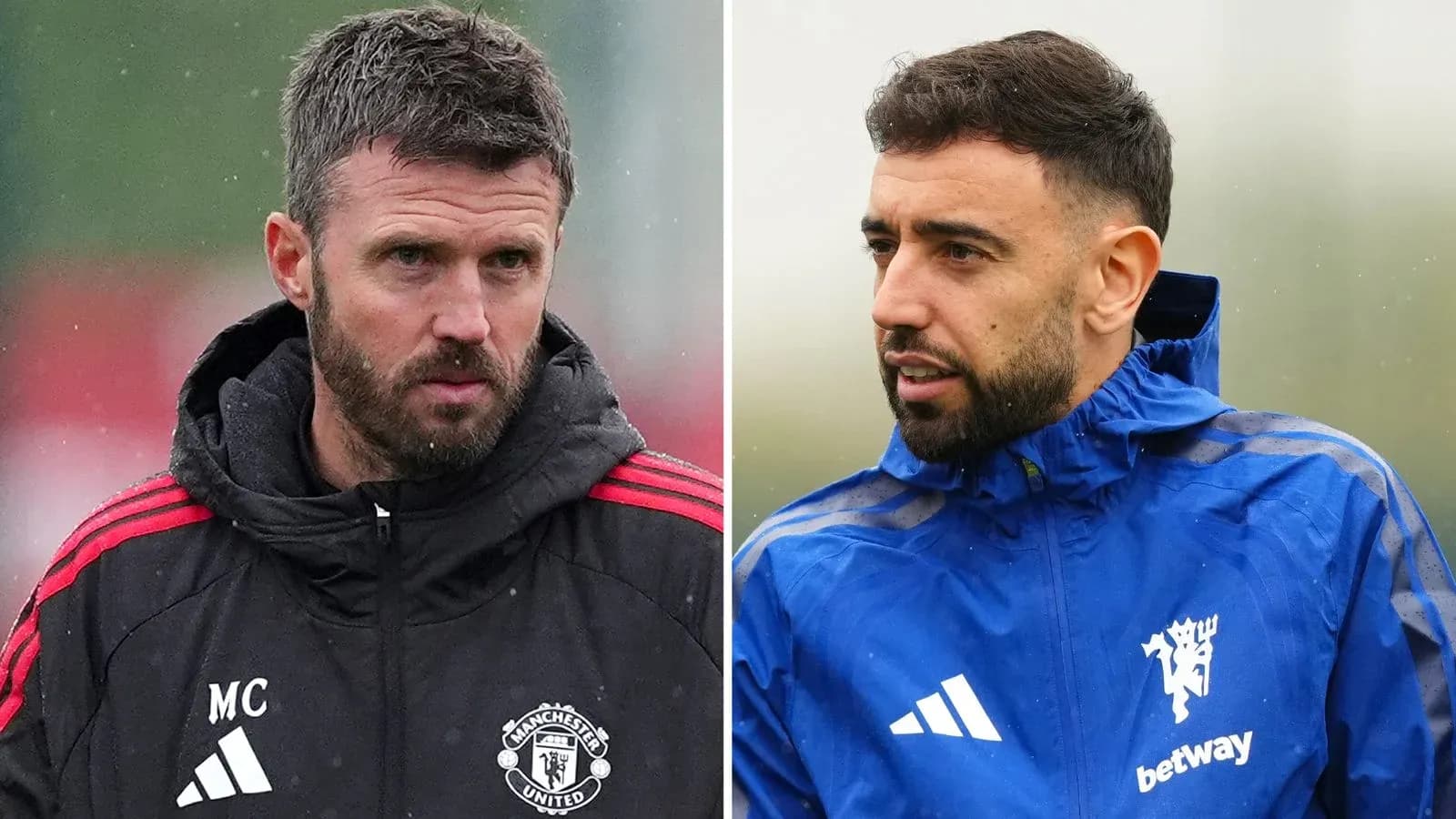
Michael Carrick walked into the room looking like a man who knew exactly what was coming. Before a single question was asked, he took control.
No preamble. No soft landing.
“I’ll start today,” the Manchester United head coach said, then spoke for more than five minutes without pause – an emotional monologue that laid bare the state of a club drifting and a manager refusing to let it sink on his watch.
United have not won in seven matches, their worst run since 2015. A 4-1 humiliation at Como in the Champions League has turned anxiety into open crisis. The mood has spilled beyond the pitch, with captain Bruno Fernandes and Lisandro Martinez voicing their frustrations in public over the last fortnight.
The knives are out. Carrick knows it. And he is choosing to fight.
“It’s not divided”
The obvious question came quickly: is the dressing room split?
“It’s not divided,” Carrick replied, firm and unflinching. “We just need to get back to doing what we do best. And we will.”
The word “will” hung in the air. It sounded less like hope, more like a promise.
The pressure on the 43-year-old has intensified since that collapse in Como, where Fernandes questioned the tactics used by the coaching staff. The captain’s comments have been widely criticised by former United players, who see a line crossed when the dressing room spills into the public domain.
So would Carrick punish Fernandes? Strip him of the armband? Drop him?
“The most important thing for me is the team and the dynamics in the squad. It is about the football club,” Carrick said. “Whatever the situation is I will always do what is best for the football club.”
He refused to confirm whether he had spoken directly to Fernandes about the outburst. Those talks, if they have happened, will stay behind closed doors. But Carrick did reveal he has spoken to the hierarchy, who are understood to be increasingly concerned about the team’s form and trajectory.
“It is pretty obvious how we are all feeling,” he admitted. “The responsibility for me to be in this position is to lead. It is my responsibility what goes on on the pitch.
“I will hold that umbrella for me to get wet and everyone else to stay dry. That is the privileged position I am in.”
It was a striking image: Carrick as the shield, willingly absorbing the storm while trying to protect a squad struggling to live up to the shirt they wear.
“We’ve lost our way”
If the answers to the questions were defiant, the opening statement was something else entirely – part confession, part rallying cry, rooted in the history of a club that has always demanded more.
“Recently we haven’t had a good time, that’s pretty obvious,” he began. “I totally accept that, what we’re going through at the moment.”
He spoke of the first five months of his tenure, a period of “relative success” when the team looked like it had an identity, a purpose, a connection with the stands. That has gone.
“We haven’t done well enough lately… we’ve had a spell that we’re really not happy with. Wednesday was a bad night, it was a bad night for a lot of reasons and it was a bad night that hurt a lot. It hurt me to see us play that way.”
The supporters, he stressed, are central to everything. The anger and disappointment in the away end in Como clearly hit him hard.
“For me to see the supporters have to make the effort and the time and spend the money to come and support us on Wednesday and have the feeling after the game, like we all felt, was a tough moment.”
His job, he said, is simple in theory and brutal in practice: put a team on the pitch that looks like Manchester United.
“My responsibility is to get a team on a pitch that represents this football club, represents the supporters and they can be proud of it with the identity that we show. We have gone away from that just recently in certain games, which I’m totally fully aware of and definitely doing something about.”
Then came the line that cut through the room.
“We’ve kind of lost our way a little bit if I’m totally honest and we’ll get it back. I’m totally confident we’ll get it back.”
Values, not excuses
Carrick leaned heavily on the club’s traditions – not as a shield, but as a standard he insists his players must reach.
“The foundation of this football club and the values of this football club have been put down and etched for many years and I totally understand and I get every single one of them.
“It comes down to humility, it comes down to being humble, it comes down to being hard-working and being really proud to work hard and being proud to live up to their values.”
He talked about resilience. About comebacks. About late goals and sustained success. Not as nostalgia, but as a reminder that this place was built on something tougher than talent.
“There’s a resilience in this football club that runs very deep,” he said. “I’ve seen it with my own eyes, I’ve felt it.”
Names followed. Ryan Giggs. Wayne Rooney. Sir Alex Ferguson. Sir Matt Busby. Sir Bobby Charlton. Not as decoration, but as examples of people who always put Manchester United before themselves.
“It was never about Ryan Giggs, it was about Manchester United,” Carrick said. Rooney, the club’s record goalscorer, was praised for sacrificing himself for the team. Ferguson, “the best manager of all time” in Carrick’s eyes, had one overriding priority: Manchester United.
“Manchester United is always bigger and always has been, always will be bigger than any single individual. Bigger than me, bigger than any of the players and it always has been.”
That, for Carrick, is the non‑negotiable.
“Entitlement cannot be at this football club”
If there was any doubt about his stance on standards inside the dressing room, he removed it.
“Respect this football club, respect what it takes to be here, what it takes to win, what you have to do to win,” he said. “I’m not entitled to be here, entitlement cannot be at this football club, we’re not entitled to win.”
The message to his squad was clear: history is not a shortcut.
“We’ve won in the past, we’ve got an incredible history but that doesn’t mean that you’re entitled to just win. I’m fully aware of that, it takes hard work, it takes a lot of sacrifice.
You’ve got to invest yourself in the football club and you’ve got to do a lot of things that maybe aren’t so nice but you’ve got to do it for each other and you’ve got to win.”
He promised he would not let those values slip.
“Again, it was based on being humble, having humility and hard work and we can never lose that and I won’t let us lose that.”
A brutal run ahead
Defiant words are one thing. The fixture list is another.
United’s next six games will test every claim Carrick made.
- Bournemouth at Old Trafford in the Premier League.
- Chelsea away at Stamford Bridge.
- Roma at home in the Champions League.
- Aston Villa at home, followed by a trip to Anfield to face Liverpool.
Bournemouth and Villa come with the added spotlight of live television coverage. Chelsea and Liverpool bring their own unforgiving scrutiny. Roma carry the weight of Europe and the memory of what happened in Como.
This is not a gentle runway for a team trying to rediscover itself. It is a gauntlet.
Carrick, though, chose not to flinch. He spoke of being “inspired” by the club’s history, of being driven to live up to what he has seen and felt as a player and now as a manager.
“We’re in a moment where it’s not gone well so we need to show exactly what it means,” he said. “Moving forward, we’ve had it, we’ve kind of lost our way a little bit… and we’ll get it back. I’m totally confident we’ll get it back.”
The question now is no longer whether he understands what Manchester United should be.
It is whether he will be given long enough to prove he can drag it back to where he insists it belongs.