Lionel Messi's Quiet Farewell to International Football
Lionel Messi walked alone.
After 120 minutes in suffocating heat, at 39 years of age, he stood on the touchline with a silver medal hanging from his neck, eyes glassy, the noise around him fading into a blur. No outburst. No grand speech. No theatrical farewell. Just a man absorbing the end.
He drifted back onto the grass, that same stretch of turf he had once left convinced international glory would never be his. This time he sat down, slowly, and began to unlace his boots. One last time for Argentina.
No cameras had been invited into a dressing room for a glossy “Last Dance.” No farewell tour. No sit-down tell-all. It was entirely in character. From the days when a four-year-old in Rosario was told he was too small to play with the older boys, Messi has always trusted his football to speak more clearly than any words.
Now, after more than two decades in the sky-blue and white, it has finally fallen silent.
The numbers and the noise
The facts are stark. Messi leaves the Argentina national team after 207 matches, nine finals and four major trophies, crowned by the World Cup in 2022. His final act ends with defeat to a superior Spain, but no result can dilute the scale of his contribution or the arc of his story.
From this vantage point in 2026, with a 39-year-old who has completed every dream he once scribbled in his head, it is easy to forget the years when his international career was treated as a running joke. The refrain was relentless: he could do it for Barcelona, so why not for Argentina?
The criticism did not just come from rival fans. It came from his own. Messi and his family endured a torrent of abuse, suspicion and, at times, outright hostility from sections of Argentina’s support and media. Some of the same voices that now deify him once questioned his commitment, his character, even his nationality.
Four consecutive lost finals hardened those doubts. The heartbreak in 2014, the Copa America defeats, the penalty miss against Chile in 2016 that pushed him to announce, briefly, that he was done with the national team. He walked away once. He came back. The tide, slowly, turned.
The making of La Scaloneta
The shift did not happen by accident. It came with a new core and a new culture.
Lionel Scaloni, once a stopgap, became the architect. Around Messi grew a spine: Rodrigo De Paul’s relentless energy, Cristian Romero’s edge, Emiliano Martínez’s defiance. The old guard of Ángel Di María and Nicolás Otamendi stayed just long enough to bridge eras and belief.
Then came 2021. At the Maracanã, against Brazil, Argentina finally broke the dam. The Copa America title on enemy soil felt like a cleansing. Once the first trophy arrived, the rest followed in a flood.
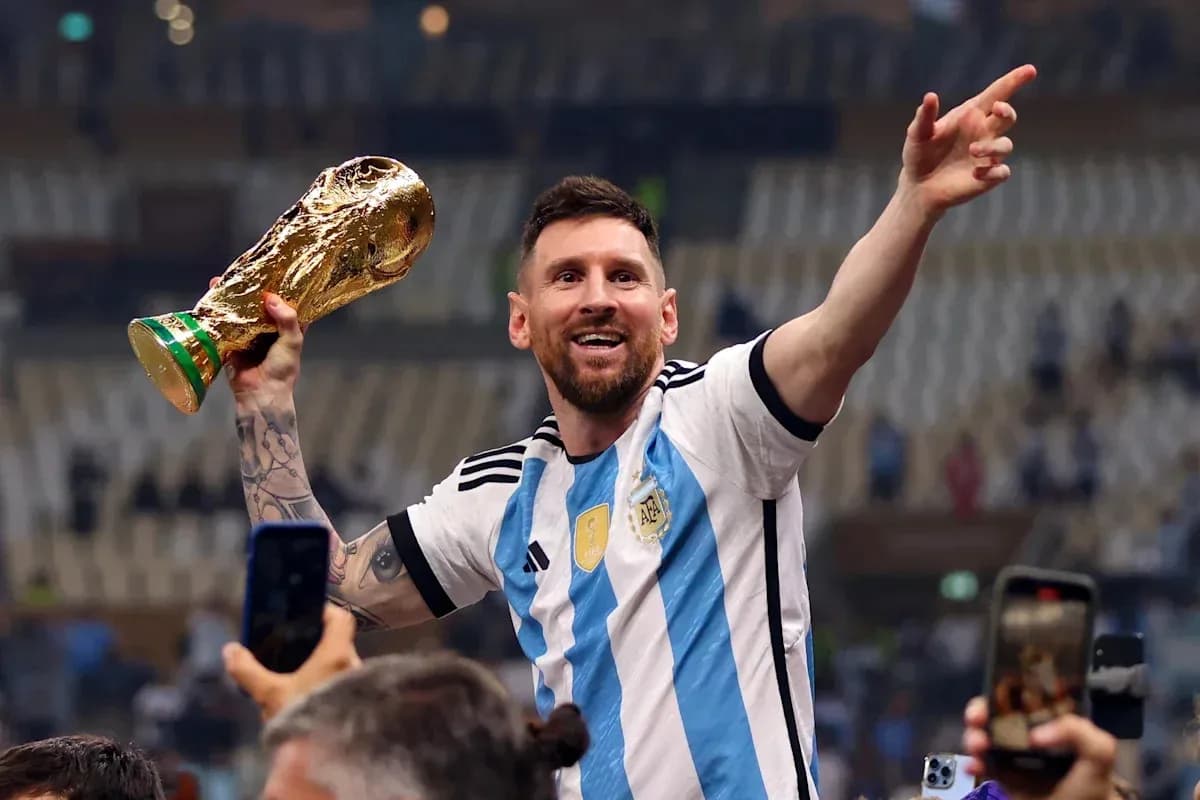
New blood surged through the squad. Enzo Fernández, Julián Álvarez and a new generation turned Argentina into a machine. Apart from that shock against Saudi Arabia, they rolled over almost everything in their path, stacking trophies and swagger, and lifting the World Cup in Qatar. La Scaloneta became the team nobody wanted to face, powered by a group willing to run themselves into the ground for the captain they idolised.
From that moment on, Messi was no longer the symbol of Argentina’s failures. He was the standard of its greatest era.
From “failure” to reference point
By the time he walked out for his final match, an entire generation of schoolchildren had never seen Argentina lose a knockout tie with him on the pitch. The player once mocked as an international nearly-man had built a record so heavy that critics swung to the opposite extreme, muttering that international football must be bent in his favour.
Strip away the noise and the numbers remain absurd. Ninety-one goals in a calendar year. Eight Ballons d’Or, four of them before his 26th birthday. A career total of 1,348 goal contributions and 44 trophies. Records that may not be touched for decades, if at all.
Yet that is not what football loses most with his departure. What disappears is a particular kind of magic. Because this sport is not an equation. It is closer to a canvas. Messi painted on it like nobody else.
More than statistics
Talent explains part of it, but not all. It does not fully account for how he dragged Argentina back to another World Cup final in his late thirties, outplaying stars closer to his children’s age than his own, while dealing with the anguish of a father on his deathbed.
It does not explain how a man who has conquered everything still attacked each game as if it might be his last.
Writers have spent years trying and failing to capture his impact. Maybe that is the point. His true legacy lives in what cannot be measured: the way fans reacted, the way time seemed to slow when the ball reached his left foot, the collective intake of breath in stadiums on every continent.
Every supporter carries a different Messi reel in their head. Some will cling to the solo runs that shredded Real Madrid, Athletic Club or Getafe. Others will see the cutbacks from Jordi Alba, the telepathy of MSN, the symphony with Xavi and Iniesta. Many will always picture him on podiums: Champions League nights, La Liga coronations, and finally the World Cup lifted into the desert sky.
La Pulga gave the game thousands of moments. The greatest gift, though, was the sensation of watching someone who had solved football. Someone who saw patterns before they existed. Someone who understood space, rhythm and pressure at a level that made the rest look like they were playing a different sport.
Billions of people have kicked a ball. Very few have made the simple act of a first touch into space feel like theatre. A wall pass, a body feint, a dummy that sends a defender spinning the wrong way – in his boots, routine actions became spellwork. Then came the passes only he could see, the angles only he could exploit, the defences only he could unpick.
And on top of all that, he scored more than anyone.
A child’s game, perfected
His retirement from the international stage hits in a way that strips away adulthood. The tears of a toddler watching him leave do not feel excessive; they feel accurate.
No degree, no job, no grown-up perspective can fully rationalise it. Football is still a children’s game, only now played and coached by adults for extraordinary sums of money. Messi never let the core of it – the joy, the wonder – slip from view. He reminded the world, again and again, why this sport captured us in the first place.
Nobody wants him to stop, because nobody wants that feeling to end. In some corner of every fan, there is still a kid tugging at his sleeve, begging him to stay.
The generation he raised
Very few athletes combine the talent to become an icon with the emotional intelligence to lead like one. Messi did both.
He inspired a generation that sold possessions to cross oceans just to see him live. Kids sprinted home from school to catch his latest performance at the old Camp Nou. Others grew up in Argentina’s youth ranks, dreaming of sharing a pitch with the man whose posters covered their bedroom walls.
Those youngsters eventually stood beside him in national colours. They chased lost causes, threw themselves into tackles and ran until their legs gave out, because they understood what he had endured to reach that World Cup trophy. They had watched him fail, watched him cry, watched him come back when it would have been easier to walk away.
People liked to say football owed Messi a World Cup. The players around him knew the game owes nobody anything. They had to deliver it. They did, not just for themselves, but for the captain who had spent a decade moving heaven and earth for his country.
The man behind the legend
Perhaps the most telling tribute in these days after his announcement is what former teammates choose to highlight. The messages flooding in are not only about the goals, the dribbles or the medals. They are about the person.
They talk about a captain who listened, a leader who shielded, a teammate who encouraged. A friend. Messi reshaped the sport, but he also elevated those around him, not through grand speeches but through example and quiet demands.
His genius made him unforgettable. His selflessness made him universally easy to support. It is that combination that allows him to walk away from international football as an undisputed champion, in every sense.
The final stage
His career is not over. Not yet. He will keep playing, most notably in Miami, where he has already shown that the goals still come in bursts – four of them just last week. The competitive edge remains, but the stage is different now. The World Cup final feels like the last truly high-stakes match of his life.
There is something faintly unjust about that. At 39, he has just reminded the world that, on any given pitch, he can still be the best player out there. Yet there is nothing left for him to prove. Not to doubters. Not to fans. Not even to himself.
So he slipped off his boots, sat in the middle of a field that has defined him, and let the moment wash over him. No grandstanding. No speeches. Just the quiet conclusion of the greatest international career the game has seen.
Argentina will play on. New idols will emerge. But there will never be another number 10 quite like the one who just walked away.
The question now is not what more Messi can give to football.
It is how long the sport will spend trying to fill the space he leaves behind.