Kevin De Bruyne and Martin Ødegaard Shine in Champions League Clash
Kevin De Bruyne lit up the night. Martin Ødegaard decided it.
On De Bruyne’s first start of the season for Napoli, the old conductor stepped back onto the European stage and immediately took hold of the tempo. Restricted to just three substitute appearances in Serie A so far, he looked anything but short of rhythm, dictating play and constantly asking questions of Arsenal’s midfield.
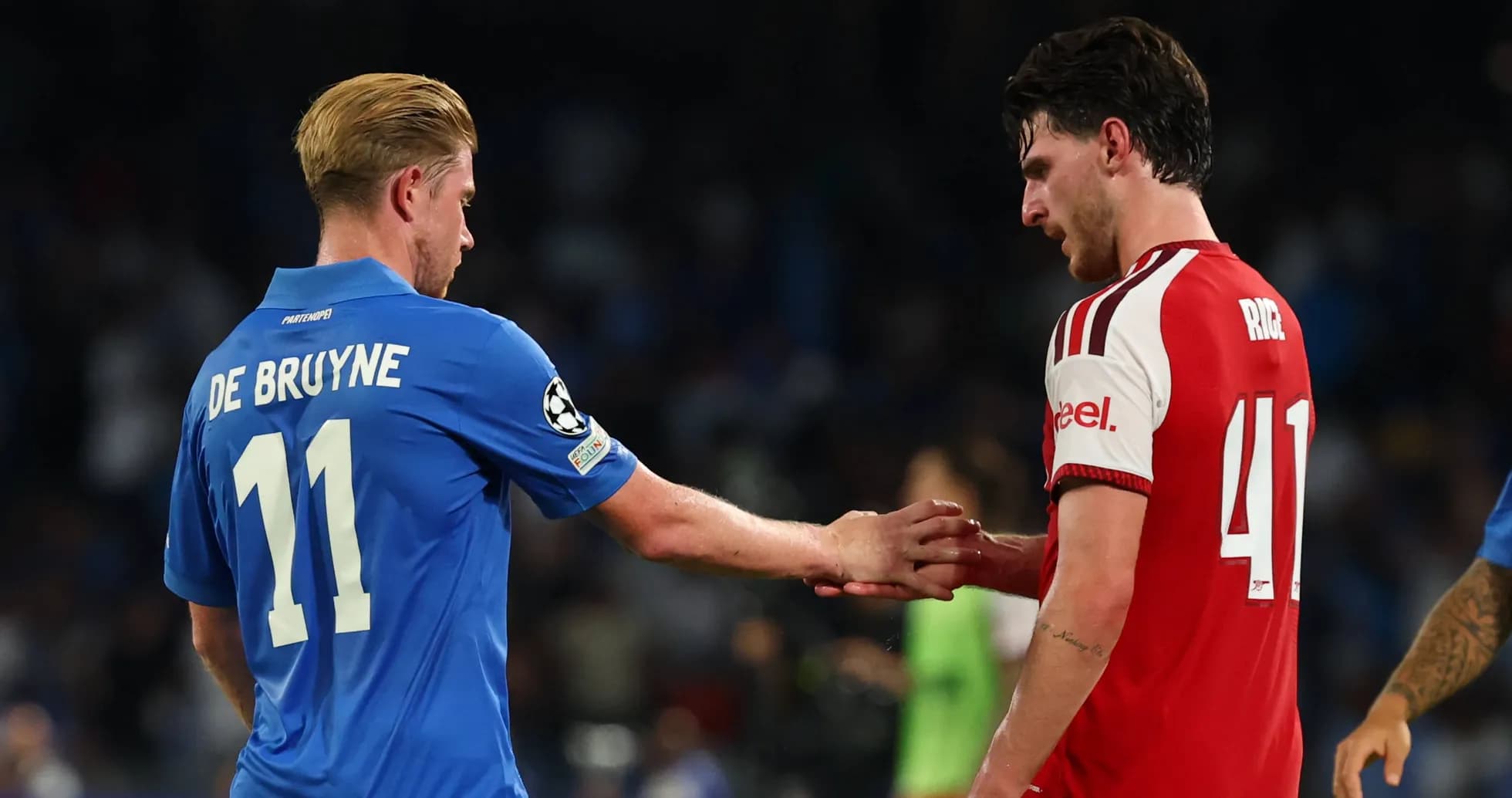
Declan Rice has seen this film before. He has felt the spaces De Bruyne finds, the little darts into pockets that drag defences out of shape. Speaking to Prime Video after the game, Rice’s respect was obvious. Even in defeat for Napoli, the Belgian had “caused a lot of problems” and drifted into “really good spaces”. Rice admitted it was “really nice” to face him again after so many battles in England. That’s not the language of a man relieved to have survived. It’s the tone of someone who knows he has just gone up against one of the game’s sharpest minds.
On the touchline, there was another reunion. Mikel Arteta, once the assistant at Manchester City helping fine-tune De Bruyne’s genius, greeted his former player warmly at full-time. The admiration hasn’t faded with distance or time. In his post-match media duties, Arteta didn’t bother hiding it. If there is a Napoli player he cherishes above almost all others, he said, it is Kevin De Bruyne – a footballer he had the “luxury to train” and work with for almost four years. To Arteta, the Belgian is “one of the best midfielders ever” and still “a joy to watch”.
The feeling travelled both ways. De Bruyne, now wearing Napoli blue but still carrying the same authority, returned the compliment by branding Arsenal “maybe the best team in the world.” On this evidence, they are at least playing like a side determined to sit at that table.
For long stretches, De Bruyne owned the tactical battle in the middle of the pitch. He dropped deep to collect, slid passes between the lines, and forced Arsenal to constantly adjust their shape. Yet when it came to the decisive moment, it was Arsenal’s own playmaker who seized it.
Late on, with the game still in the balance, Martin Ødegaard found the space and the finish that De Bruyne had been hunting for all night. One clean strike, one flash of that left foot, and Arsenal had their breakthrough. In a match shaped by two cerebral No 10s, it was the Norwegian who wrote the final line.
The goal did more than settle a contest. It gave Arsenal exactly what they craved: a perfect start to their new Champions League campaign, and a statement that last season’s heartbreak against PSG in the final has hardened rather than broken them. This is a team that wants to go one better, and winning away in Italy against a Napoli side led by a rejuvenated De Bruyne carries real weight.
There was another layer to the result. Arsenal didn’t just win; they shut out an attack built around one of the most inventive players of his generation. For a club that prides itself on its evolving defensive steel under Arteta, keeping De Bruyne and Napoli scoreless will echo in dressing rooms across Europe.
For De Bruyne, this night still mattered. The performance, full of craft and authority, sent a clear message: after injury, after a slow domestic start, he is nowhere near finished at this level. His legs may have more miles on them, but his brain remains several steps ahead of almost everyone else on the pitch.
Napoli will need that version of him. The defeat extends a losing streak they are desperate to snap, and the visit of Bologna now carries extra tension. Their margin for error is shrinking.
Arsenal, by contrast, stride back into domestic action with their shoulders back. The reigning Premier League champions head to Sunderland on Sunday buoyed not just by three European points, but by the knowledge that when the game tightened and the spotlight grew harsh, their captain delivered and their defence held firm.
On a night framed by respect for one great midfielder, it was the other who nudged Arsenal’s season onto a potentially defining path.