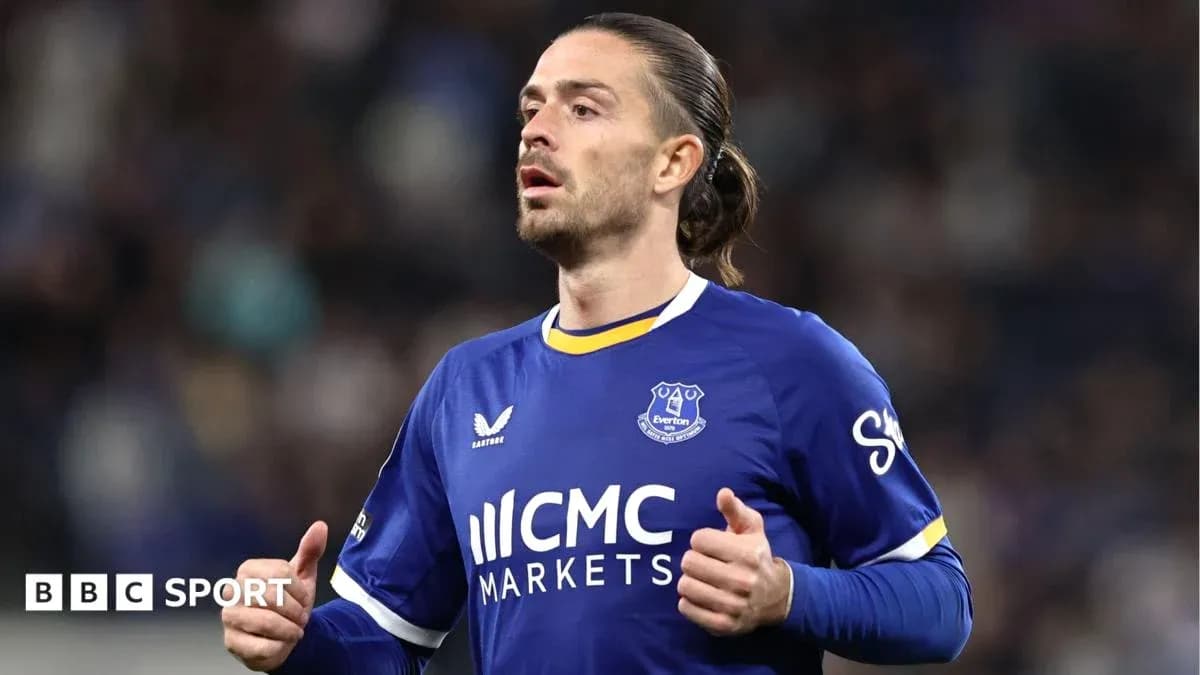
Jack Grealish's Everton Return Under Strain After Training Breach
Jack Grealish eased his white Lamborghini through the gates at Finch Farm an hour before the transfer deadline and the mood around Everton changed. For a fanbase numbed by a bleak summer, here was a jolt of colour and noise, a returning hero rolling back into town.
His first loan from Manchester City had ended with a serious foot injury, but in those fleeting months he had given Evertonians enough flickers of class and chaos to feel like one of their own. When he finally left in the early hours, deal signed, every autograph scribbled, every selfie taken, it felt less like a temporary arrangement and more like a homecoming.
It was also a gamble. For David Moyes, operating with just 18 senior players after a botched window and cautious owners. And for Grealish, exiled from City in the final year of his contract, effectively told his time at the Etihad was over. Everton were offering a way back to the elite. He was offering them star power, personality and, they hoped, end product.
Now that pact is under strain.
A public rebuke and a private reckoning
Everton’s statement before the Carabao Cup tie against Newcastle was brief and brutal: Jack Grealish had been left out for “a breach of club discipline”. The detail was simple and damning. He had failed to report for training on Monday.
For a player who once became Britain’s first £100m footballer when he left Aston Villa for Manchester City in 2021, it was a jarring lapse. Everton’s choice to go public before a ball had been kicked underlined the seriousness of the offence. This was not something to be brushed away as a minor internal matter.
The timing makes it feel like a crossroads. If it goes wrong here, if he cannot make it work at Everton, the slide from the Premier League’s top tier starts to look less like a risk and more like an inevitability.
The club, though, are not dressing this up as some grand “Last Chance Saloon” ultimatum. Moyes simply does not have the numbers to cast aside a player who, on his best days, can change games. But the margin for error has shrunk. So has the patience of those who had happily adopted him.
The manager will hope this proves a sharp lesson, not a fatal one. Wembley has suddenly appeared on the horizon in the Carabao Cup, and Everton cannot afford self-inflicted wounds.
Moyes’ values, Grealish’s reality
There have been occasional issues with Grealish’s time-keeping before, but nothing on this scale. Inside Finch Farm, he is generally regarded as a hard trainer, someone who keeps himself in decent condition and buys into the work. That made Monday’s no-show all the more jarring.
Grealish has since held talks with senior figures at the club. The message, under a disciplinarian like Moyes, will have been blunt: this cannot happen again. Not in this squad. Not in this situation.
The decision to drop him came from high within the club, with Moyes fully behind it. The punishment was inevitable. The consequences are not.
Complicating it all was Everton’s performance without him. They produced arguably their best display of the season, beating Newcastle United 3-1 to book a quarter-final at League Two Fleetwood Town, the same Fleetwood who had dumped out Premier League champions Arsenal in the last round.
On the left flank, where Grealish might reasonably have expected to start, 20-year-old Tyrique George brought a directness and energy that suited Moyes’ preferred tempo. The contrast did not go unnoticed.
Moyes chose his words carefully afterwards.
“You probably know I’m not going to give any details. It’s a club decision and I support it. It’s something I don’t want to speak too much about,” he said.
Then came the line that cut to the heart of it.
“The one thing about Everton is that they have got real good values. All the players stand behind it and accept the values, on the pitch and off the pitch, and I think the players did a good job.
“It is a small squad, but we are doing our best to keep challenging. We are not accepting any excuses for anything and I think the players are doing a great job. There was a humility about us.”
He did not name Grealish. He did not need to. Every sentence spoke to what he expects, and what he had not seen.
A bond under strain
The disappointment cuts deeper because of the relationship between the two men. Moyes and Grealish clicked almost instantly when the move was first discussed in August 2025. Grealish was clear at the time: “As soon as I spoke to the manager, I knew there was only one place that I wanted to go and that was Everton.”
This was not a reluctant loan, a stopgap. Here was a Treble winner with Manchester City in 2023, a player who had lived the highest level, choosing a club in flux because he felt something there.
He backed that up when injury struck. After fracturing his foot in Everton’s 1-0 win at Aston Villa in January, he could have gone back to City to complete his rehabilitation. He stayed on Merseyside instead, working at Finch Farm, around the same staff and teammates he had grown attached to.
Everton, for their part, did not rush into a second loan. They weighed the injury, the cost and, yes, the character. Moyes knew he was taking a risk, but with owners The Friedkin Group stepping away from serious squad investment as they prepared to sell, his options were limited. Grealish’s insistence that Merseyside was where he wanted to be tipped the balance.
On the pitch this season, the return has been modest. No goals, no assists in eight appearances – six for Everton, two earlier for City – and a habit of slowing the play that jars with Moyes’ demand for intensity. The manager’s anger this week will have been sharpened by that reality. A thin squad cannot carry passengers, and it certainly cannot afford players ruling themselves out through avoidable lapses.
The contradiction at the heart of Grealish
Inside Everton’s dressing room, Grealish is adored. Staff around the club talk about him as “a lad with a heart of gold, kind and charming, who actually loves being here”. That is not PR spin. It is backed up by what he does away from the cameras.
Recently he donated £10,000 to a GoFundMe page for Everton supporter Leon Skapars, a 36-year-old father of three diagnosed with cancer. Skapars’ wife, Crystal, spoke of what that gesture meant.
“In that moment, Jack gave our whole family something we desperately needed, hope. What he has done for our family is something we will never forget. It makes us feel incredibly emotional.”
This is not an isolated act. Grealish presented awards at the Daily Mirror’s ‘Pride Of Britain’ event, telling the audience: “Footballers are classed as heroes – but these are the real heroes.”
In April, he extended his role as principal ambassador for Special Olympics Great Britain by three years, having first taken it on in 2022. To mark the extension, he hosted five of the 10 Special Olympics GB athletes who completed the London Marathon at Everton’s Hill Dickinson Stadium, giving them a VIP day, a stadium tour and time on the pitch with him.
At Finch Farm, he is often the first to volunteer for community events, including sessions with the Everton in the Community Down Syndrome team. He speaks often about the inspiration he draws from his sister Hollie, who has cerebral palsy.
This is one side of Jack Grealish: the engaged, empathetic, generous figure whose presence lifts people around him.
The other side keeps dragging him back into the headlines.
In April, he was photographed asleep at a Manchester rooftop bar, surrounded by drinks. No law broken, but hardly wise for a player rehabilitating from injury in an era where every phone is a camera. Earlier in his career, in March 2020, he broke lockdown guidelines while at Aston Villa, was fined by the club and apologised publicly. In November that year he admitted two counts of careless driving after incidents involving a Citroen van and a Mercedes.
Put the two sides together and you get the contradiction that has always defined him. Ask around football, especially at Everton, and the character references are glowing. That is what makes this week’s breach of discipline sting. People want to believe in him. Many still do.
But belief needs backing.
Now or never?
This is not yet the end of the road for Jack Grealish at Everton. Moyes cannot afford to turn a Treble winner into a permanent spectator. The squad is too small, the season too demanding, the stakes too high.
What has changed is the context. Everton have shown they can produce their best performance of the campaign without him. A young winger has stepped into his space and thrived. The club has nailed its colours to the mast on discipline and values, and done so publicly.
From here, the path is brutally clear. Either Grealish responds – sharper, hungrier, fully aligned with the standards Moyes demands – or this latest misstep becomes the moment his career at the top began to slide away.
For a player who once cost £100m and carried the hopes of club and country, how many more warnings can there be?