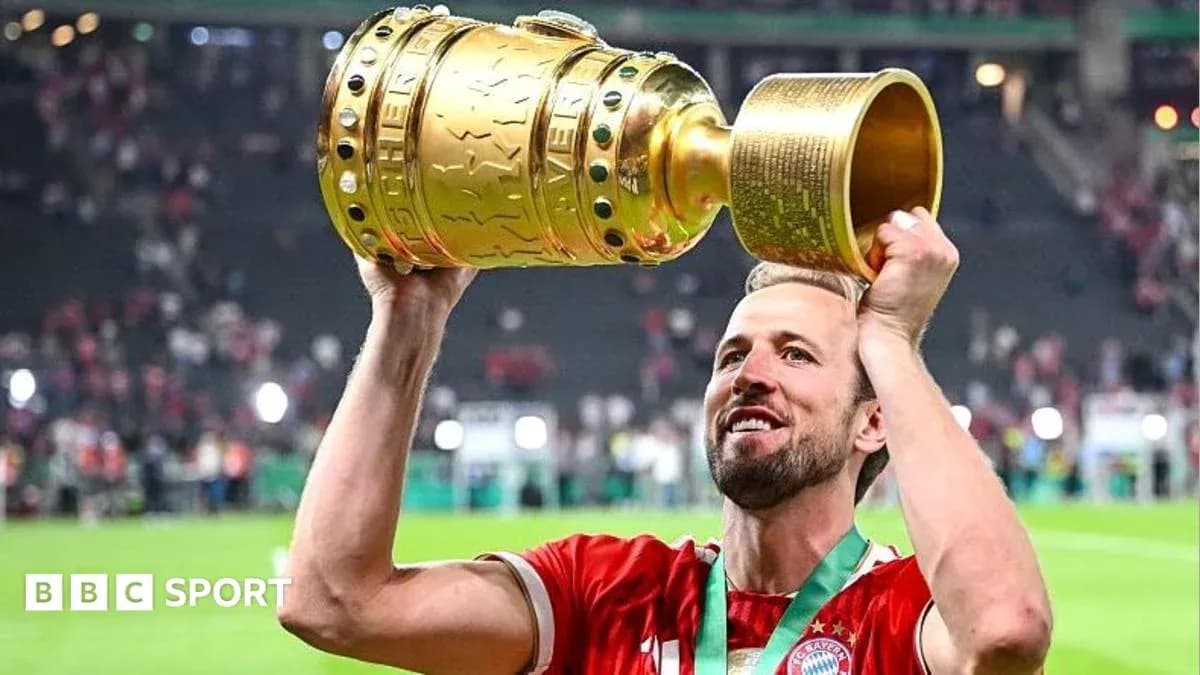
Harry Kane: The Evolving Centre-Forward Dominating European Football
Harry Kane is standing almost on the edge of his own box when the ball comes to him. A centre-forward, 73 goals in his last campaign, collecting possession where most strikers would never bother to wander.
This is the version of Kane that has quietly taken over European football.
He is 33 now, deeper than ever, yet more dangerous than at any point in his career. The numbers are absurd: 73 goals last season for England and Bayern Munich while operating in areas that used to belong to holding midfielders and playmakers. The paradox makes him smile.
“Until you really understand football and understand what we've been talking about, it's so easy to say 'stay high, you're going to score' but it doesn't work like that,” he says.
The striker who looks like a coach
Watch Kane in training and the picture becomes clearer. England’s record goalscorer is one of the first out on the grass. Younger players mess around with kick-ups; Kane stands a little apart, talking with a member of staff, scanning, listening. From a distance, you could mistake him for a coach.
Given what he does on the pitch, it would be an honest mistake.
His game mirrors his personality: rounded, understated, relentlessly professional. Those around him talk about a humble character who carries himself the same way off the pitch as he does on it. No fuss, no noise, just an obsession with getting every detail right.
The new season has barely begun, but there is no hint of him easing off after the most prolific 12 months of his life. With only five days of pre-season work, he still completed 90 minutes in Bayern’s 2-1 win over Borussia Dortmund to lift the German Super Cup. The role he plays is punishing. The way he carries it looks effortless.
The data backs up the eye test. Across the past six seasons, STATSports – the company he has invested in as well as worn – tracked his physical output: distance covered up 8%, high-speed running up 22%, accelerations up 42%. At an age when many forwards start trimming their game, Kane has expanded his.
Thriving in a man-to-man world
The tactical backdrop has shifted too. Pressing is harsher, braver, more personal.
“Over the last five or six years, man-to-man pressure has become bigger,” Kane says. “European football is physical and top teams are trying to win the ball back high, trusting their defenders and midfielders to defend man for man to win their battles.”
Clubs have responded by hoarding athletes and dribblers, players who can turn one-against-one duels into territory and chances. Kane is not one of the game’s great dribblers. He is not the fastest. He says so himself.
Yet he has found his own way to dominate those same duels.
Take that Super Cup against Dortmund. At one point he drifted deep, looking for a pocket of space. Two defenders saw the danger and jumped towards him. This is where his dribbling looks different. Less about step-overs, more about thought.
He dropped his body low, used his strength to shrug off centre-back Waldemar Anton, then rose and nudged his weight slightly to the right. A tiny adjustment, almost nothing to the naked eye. But those are the movements that swing a defensive line.
Daniel Svensson and Jobe Bellingham bit on the feint. Kane then snapped the ball back the other way, suddenly opening the whole pitch from inside Bayern’s half. One move, one change of angle, and the game was stretched.
His feet are good. His brain is quicker.
Half coached, half instinct
Bayern boss Vincent Kompany has already tried to explain the role, describing it as 50% coached, 50% Kane deciding in real time.
Kane agrees – and relishes that freedom.
“I think it's partly instinct, using my football brain and getting the feeling on the pitch,” he says. “If, for example, I want to drop and see if the centre-back really wants to commit, he might commit into midfield, but is he going to commit if I drop all the way to my box?
“After the first five or 10 minutes you really get an understanding of how the opposition are going to play, which dictates how I play.”
Inside Bayern’s structure, what looks chaotic from the stands is anything but. Rotations appear random until you realise they follow one simple rule: as long as every zone is occupied, the names can change.
Kane sits at the heart of that idea.
“I feel like my position now is as one of two 10s, and you work together,” he says. “You can double up on one side to overload, which causes the opposition centre-backs a problem of who to mark.
“If they want to mark both, they've got to go man-to-man and then that leaves space for our wingers or full-backs to run into.
“It's posing all these questions to the opposition but, personally, I love having someone close to me who I can link with.”
This is the same player who built his reputation as a classic lone number nine, living on the shoulder, wrestling two centre-backs, waiting for service. He talks now like a creator.
“When you're the number nine on your own you can get marked by two centre-backs and you struggle to get touches on the ball,” he says. “You're relying on everyone else to find you with the ball.”
The nine who thinks like a ten
Show him the clips and the logic jumps out.
In one sequence from last season, Luis Díaz appears in the half-space as one of those “tens”. Kane has drifted off the front line, pulling a midfielder with him. The gap that opens allows Joshua Kimmich to punch a pass through to Díaz.
“The thing with our formation is, as long as there's someone in each position, it doesn't really matter who it is. Lucho [Luis Diaz] in this clip is playing as one of those 10s.
“I've come off to try and create a bit of space and Lucho's gone through the centre.”
Ahead of them, Serge Gnabry makes a run in behind, dragging defenders back and carving out a pocket for Kane and Díaz between the lines.
“I think it's Serge [Gnabry] making the run in behind which takes the defenders back, which allows me and Lucho that space in between. Lucho lays it off and whenever I'm in that position, around 20-25 yards out, I'm always looking if I can get my shot off.”
Again, the pattern repeats: he starts deep, ends up where it hurts.
“By playing deep when the play develops, I end up coming into a number 10 spot when everyone's dropped,” he says. “I can get shots off from the edge of the box, which is a big strength of mine, or I'm running off the back of players where no-one's picking me up – because the midfielder finds it hard to [track].”
The second clip comes from Bayern’s Champions League tie against Club Brugge. Usually a centre-back shadows him. This time, Brugge hand that job to their holding midfielder. Kane spots it and twists the matchup to his advantage.
Lennart Karl scores, yet Kane never touches the ball.
“These are the little runs, again, not everyone sees,” he explains. “With Jamal Musiala and Lenny, they're so good at receiving the ball and dribbling so there'll be times where I will actually stay higher and let those guys get on the ball a bit deeper, and I'll try and make runs in behind.
“Without changing my game too much, I try and complement the players around me.
“I know Lenny is so good in those pockets and when he gets there, I'm more thinking of running in behind because, one, he can play me in and I can go through on goal, or two, he can dribble with the ball and do exactly what happened here.
“As soon as Lenny gets in that pocket I make the run and not always to get the ball, sometimes it is just to drag the defender away.
“Now he's one-against-one with a centre-back in the middle of the pitch and that's dangerous for any centre-back.”
The goal goes next to Karl’s name. The move belongs to the space Kane created.
A forward who plays as a 10, a 9 and a 6
As the Ballon d’Or announcement looms, the conversation around Kane inevitably circles back to the headline figure: goals. Seventy-three of them, a tally that sits in the company of Cristiano Ronaldo, Lionel Messi and Erling Haaland.
What risks getting lost is everything wrapped around that number.
He plays for the team in every phase, in every third, while still posting individual output that belongs to the game’s most ruthless finishers. He has even described himself at times as operating like a 10, a nine and a six rolled into one.
In an era obsessed with specialists, where roles are drilled and redrilled on the training ground until they become rigid habits, Kane has carved out something different: a centre-forward who refuses to stay in his lane, yet still lives for the goal.