Michael Carrick's Defiant Message to Manchester United
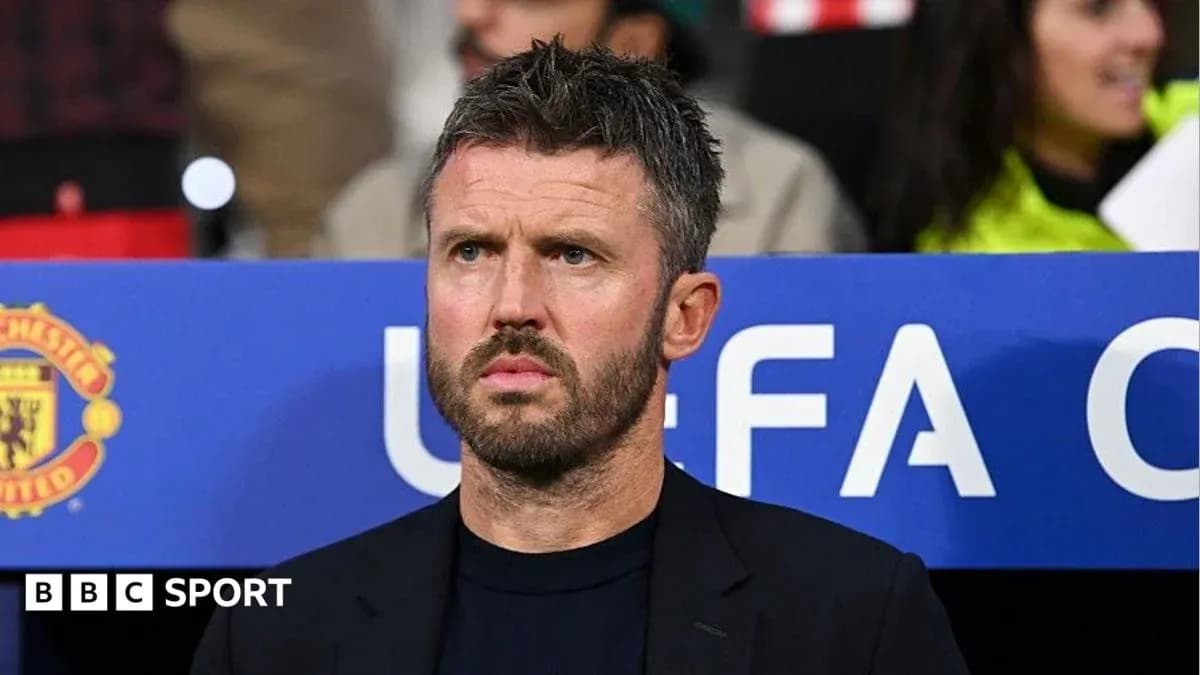
Michael Carrick walked into the press room at Carrington on Friday and made one thing clear: this was his stage, his message, his fight.
Under intense pressure after a winless run stretching to seven games and a brutal 4-1 Champions League defeat by Como, the Manchester United manager spoke for five minutes and 30 seconds without a single question being asked. No preamble, no small talk. Just a pointed reminder of what he believes Manchester United should be – and how far they have drifted.
Carrick takes the microphone
Instead of settling into his chair and waiting for the first hand to go up, Carrick told the assembled media he wanted to start. It was a move straight from the Sir Alex Ferguson playbook, though the legendary Scot rarely went on for as long.
“Recently we haven't had a good time, I think that's pretty obvious,” Carrick said. “Wednesday was a bad night, and it hurt me to see us play like that. It was unacceptable.”
The defeat in Italy did more than damage United’s Champions League campaign. It exposed fractures. Lisandro Martinez publicly criticised the club’s hierarchy. Bruno Fernandes questioned Carrick’s tactics. The noise around the club grew louder, more hostile.
Carrick chose this moment to lean into the identity of Manchester United, to talk about foundations and values rather than systems and shapes.
“My responsibility is to get a team on the pitch that represents this football club, and the supporters, and they can be proud of in the identity we show. We have gone away from that recently. It's important we all recognise that.
“The foundation and values of this football club have been etched for many years. I totally understand and get every single one of them.
“There's a resilience about this football club that runs very deep. I've seen it with my own eyes, I've felt it, I know some of the individuals closely who have been a big part of that history.
“Entitlement cannot be at this football club.
“It was based on being humble, having humility, and hard work. We can never lose that, and I won't let us lose that.”
This was not a tactical briefing. It was a line in the sand.
Captain under scrutiny
The questions, when they finally came, went straight to the heart of the tension: Bruno Fernandes.
The captain has been at the centre of the storm since Wednesday night, not only for his performance in Como but for his blunt assessment of where United stand. Club sources indicated on Thursday that Fernandes would not be stripped of the armband or fined for his post-match remarks, yet the issue hung over the room.
Asked directly whether he had considered dropping his skipper for Sunday’s Premier League game against Bournemouth at Old Trafford, Carrick did not offer any guarantees.
“The most important thing for me is the team, the squad and dynamics in the squad,” he said. “It's about the football club. I'll always do what is best for the football club.”
No promise. No public backing. Just a reminder of where, in his eyes, the power should lie.
Pressed again on whether he might remove the captaincy from the 32-year-old midfielder, Carrick repeated the same line: “I will always do what is best for the football club.”
He would not be drawn on whether he had spoken to Fernandes about his conduct. “I don't think this is the time to go into too much detail,” he said, closing that door quickly.
Fernandes challenges the narrative
While Carrick spoke of heritage and deep-rooted resilience, Fernandes had struck a very different tone in his own interview with Sky Italia after the Como defeat.
“At this club, there's too much focus on what's been done in the past,” the Portugal international said. “But we're not those people anymore. The club and the players need to understand that.
“Unfortunately for us – especially when it comes to the players – those who join expect to win trophies, win games, and reach the highest level, that's been very difficult at this club in recent years.”
Two senior figures, two contrasting perspectives on history. One leaning heavily on it, one urging the club to stop hiding behind it. Whether Carrick had heard those exact comments before delivering his monologue was unclear, but the tension between the two positions framed the entire day.
Dressing room and duty of care
With his authority openly questioned in public, Carrick was asked whether the dressing room had split.
“No, it's not,” he replied. “We just need to get back to doing what we do best.”
Unity is easy to claim, harder to prove. Results will be the only convincing evidence now.
Away from tactics and turmoil, Carrick also addressed the burglary at Fernandes’ Cheshire home on Wednesday, an incident that unfolded on the same night as the defeat.
He said the club were “doing everything” to support Fernandes and his family.
“Thankfully they weren't directly affected even though it is an awful situation,” Carrick added.
A manager on the brink, a club at a crossroads
So Carrick goes into Sunday against Bournemouth with his job under threat, his captain under scrutiny, and his team searching for an identity he insists has been lost.
He has chosen his ground: humility, hard work, no entitlement, a return to values he believes have defined Manchester United for decades.
Now comes the only verdict that matters in this business – what happens when that team walks out at Old Trafford and the whistle blows.