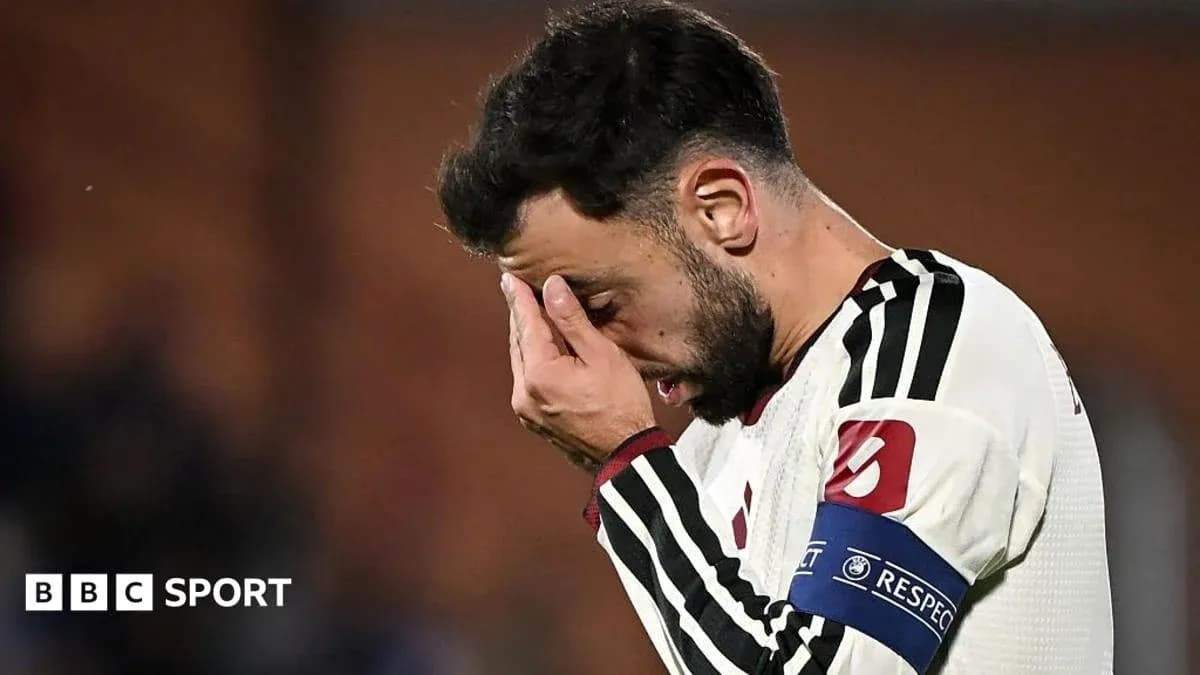
Bruno Fernandes: Should He Play Against Bournemouth?
Michael Carrick has never been short of advice on how to manage Manchester United. This week, it has turned into a roar.
At the centre of it all stands Bruno Fernandes, the captain who splits opinion in every stand, every studio, every dressing room debate. Now the argument has boiled down to one blunt question before Bournemouth arrive at Old Trafford on Sunday: does he play, or does he pay?
A captain under fire
Duncan Ferguson doesn’t see much room for nuance.
"It is a big problem for Michael," the former Everton and Rangers striker said on The Overlap podcast. "Put people in the team you trust. Your captain has thrown you under the bus. If you don't think he is playing for you, get him out. I wouldn't pick him even though he is their best player."
That last line hangs in the air. Best player. Don’t pick him.
He is not alone. Joe Smith, the respected voice of Manchester United fan channel Stretford Paddock, reached the same conclusion.
"I don't think Fernandes should play on the weekend," he said. He referenced Lisandro Martínez starting against Leeds as a warning sign: if the manager bends, the players start "running the ship".
On flights back from Como to Manchester after the 4-1 Champions League collapse, United fans had plenty to say as well. Most of it bleak, most of it directed at the club as a whole. But again and again, the conversation circled back to the captain and the coach.
Only one opinion truly matters, though. Carrick’s.
Rooney’s warning
Wayne Rooney, who knows Carrick as a team-mate and knows the heat of a Manchester United dressing room, has watched this unfold with a manager’s eye.
"When Martinez came out, I said this is an absolute nightmare because it will rip the dressing room apart," Rooney told The United Stand podcast. "That was the start. We've seen it now with Bruno and you're going to see it with more players because they don't want to take responsibility.
"I was in that situation [as manager at Plymouth and Birmingham City] and if I was in Carrick's position now, I'd come out fighting. There's no more Mr Nice Guy."
Rooney’s message is clear: draw the line or lose the room.
At 13:30 BST, Carrick will sit down in front of the cameras to preview Bournemouth. He will be asked, bluntly, if he is dropping his captain. He will not be able to dodge it.
The outburst that changed everything
Many around the club expected Fernandes to face punishment after his post-match comments in the wake of the Como defeat. He did not. He also kept the armband, even though Martínez had been fined eight days earlier for attacking the club hierarchy after the 2-0 loss to Atletico Madrid.
The contrast jarred.
"It was an assassination," said one source who has worked with Fernandes, speaking to BBC Sport about Wednesday’s remarks. "It was unprofessional. Michael's team are killing him."
The issue is not that Fernandes spoke. It is what he said, and where he aimed it. He questioned Carrick’s tactics for the Como game, and then pointed to the bench, saying it was up to the coaching staff, not the players on the pitch, to spot the problem and change it.
These were not emotional, off-the-cuff words blurted out in the tunnel. Unlike Martínez’s blast, this was measured. Fernandes is one of the sharpest tactical minds in the squad, a player obsessed with detail and desperate to win. He knew what he was saying. He chose his targets.
He also did 10 post-match interviews after the defeat, fronting up while others stayed in the background. Inside Old Trafford, some feel that workload, and the way his tone sounds harsher on the page than it did in the moment, offers a sliver of mitigation.
But the damage is done. The captain publicly questioned the manager’s job. That never goes away.
The Ferguson shadow and a different era
It is impossible to separate any Manchester United crisis from the shadow of Sir Alex Ferguson. Under him, this kind of challenge usually ended one way: the player walked.
He believed in absolute authority. Those who tested it did not last long.
Yet the game has changed. Stories from Gordon Strachan about Ferguson’s methods at Aberdeen, shared on ‘The Good, The Bad and the Football podcast’, underline just how far the culture has shifted. What worked in the 1980s would not survive in today’s climate of player power, social media scrutiny and corporate sensitivity.
Carrick cannot manage like Ferguson. He must operate in the here and now, where owners are wary of upheaval and dressing rooms are fragile.
A club stuck in a loop
United’s hierarchy are tired of sacking managers. Ruben Amorim went last season. Erik ten Hag the year before that. Each reset brings a new philosophy, a new backroom team, another expensive attempt to start again.
They do not want Carrick to be the next name on that list. But the table and the fixture list are ruthless. Seven games without a win have left him exposed. Fail to beat Bournemouth and he will match the miserable run Louis van Gaal endured in 2015-16 – the worst sequence since Ferguson’s side went nine without victory (eight draws and a defeat) in 1988-89.
That is the company Carrick is keeping now. Not the Ferguson of title parades, but the Ferguson of crisis seasons and restless boardrooms.
Can he really drop him?
All of which drags the conversation back to the same uncomfortable question: even if Carrick wants to drop Fernandes, can he?
The injury list tightens the noose. Benjamin Sesko, Kobbie Mainoo and Marcus Rashford are all out. Creativity and goals have already been stripped from the side. Removing Fernandes would take away another major source of both, even in his current form.
And that form has dipped. His understanding with Youri Tielemans, a partnership many expected to knit United’s midfield together, has never really sparked. Fernandes’ only direct goal contributions this season remain a hat-trick and an assist in the 5-2 win over Ipswich in August, plus his strike against Sabah FK on 10 September.
For last season’s PFA Player of the Year, that return is underwhelming. The influence is still there in flashes, but not with the relentless edge that once defined him.
Yet, as Duncan Ferguson said, he is still their best player.
That is the dilemma. Drop him and you make a statement, but you weaken an already depleted team for a game you dare not lose. Keep him and you risk looking like a manager who has allowed his authority to be publicly undermined.
Carrick is trapped between principle and pragmatism.
On Sunday, when the teams walk out at Old Trafford, everyone will know which one he chose. And for a coach already fighting for his future, it might be the decision that defines his Manchester United reign.