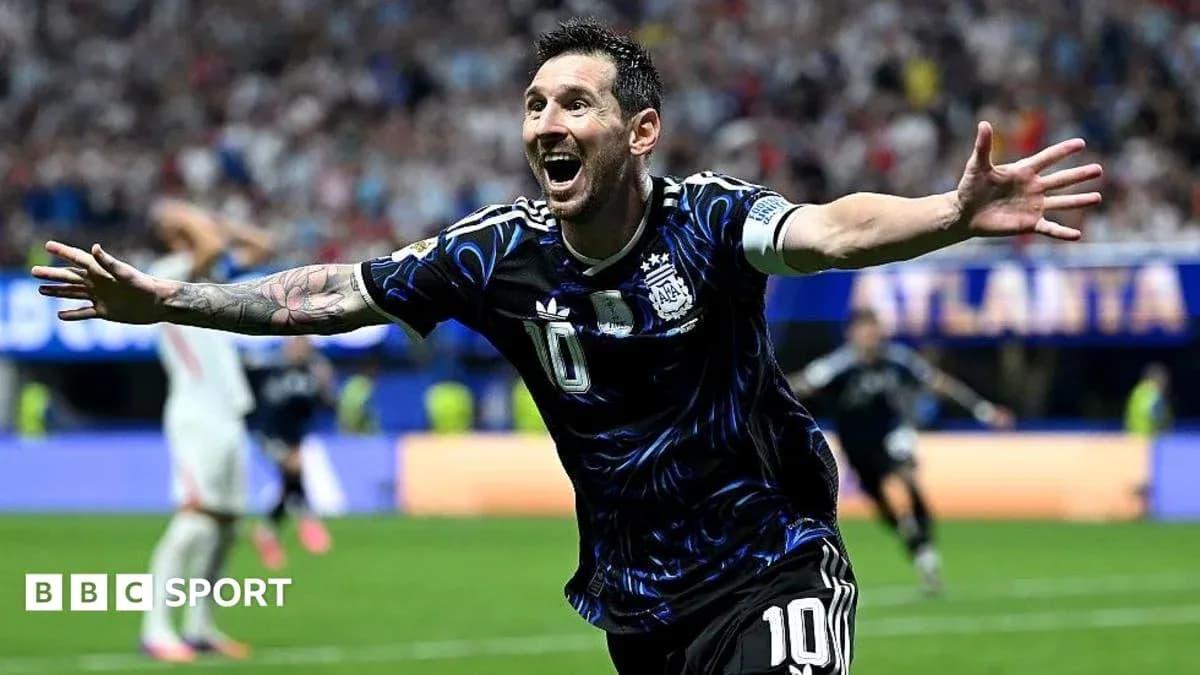
Argentine Football Pauses in 10th Minute to Honor Messi
The Argentine league will stop this weekend. Not for a VAR check. Not for a protest. For Lionel Messi.
In a gesture that underlines just how deeply he has marked the country’s footballing soul, every match in Argentina’s top flight will pause in the 10th minute for a full minute of applause, a living stadium ovation for a player who has finally stepped away from the international stage.
Messi, 39 now, walked away from the Argentina national team on Monday, closing a chapter that began in 2005 and redefined what greatness looks like in the sky-blue and white. He wore the number 10 shirt; the league will stop at minute 10. The symbolism writes itself.
“In tribute and homage to Lionel Messi's career with the Argentina national team, at the 10th minute of play in all matches the referees will stop the game and a general minute of applause will be held,” the Argentine Football Association announced. “We look forward to seeing you on the fields – join us in this recognition!”
For one minute, across a football-obsessed nation, the ball will sit still for the man who made it dance.
A Farewell Written in Finals
Messi’s last act with Argentina came on the grandest stage. He captained his country to the 2026 World Cup final, four years after lifting the trophy in Qatar, only to see Spain deny him a second world crown in July. That defeat closed his World Cup story, but not his legacy.
He retires as Argentina’s record appearance maker, with 207 caps, and its record goalscorer, with 125 goals. Only Cristiano Ronaldo has scored more in international football. Only Kylian Mbappé has more World Cup goals, with 22 to Messi’s 21.
The journey was anything but smooth. In 2016, after a Copa America final defeat by Chile in which he missed in the shootout, Messi walked away once before. It was Argentina’s fourth major final loss in nine years, and it broke him enough to say he was done. He came back. He then delivered the World Cup and two Copa America titles, dragging the national team from nearly-men to serial winners.
The arc is stark: from the image of a distraught Messi in New Jersey in 2016 to the one of him in Lusail, bathed in gold in 2022. The applause in minute 10 is for both versions.
A Legend Who Never Came Home
There is another layer to this tribute. Messi is Argentina’s greatest footballing export, yet he never played senior club football in his homeland.
He left for Barcelona’s La Masia at 13, a small boy chasing treatment and a dream. Everything that followed – the Ballon d’Ors, the records, the goals – unfolded in Europe and now in the United States. The Argentine league never had him as a player, so it will claim him now in the only way it can: by stopping, collectively, to say thank you.
Messi’s international debut came in 2005, a 63rd-minute substitute in a 2-1 friendly win over Hungary. From that moment to his final bow in 2026, he became the constant in a changing Argentina, the reference point for a generation of teammates and a country that demanded everything and then a little more.
- Eight Ballon d’Or awards.
- Two Copa America titles.
- One World Cup.
- Records across competitions and continents.
- And now, a league-wide standing ovation.
Football, Family and the Next Chapter
This final retirement has a more personal weight. In August, Messi admitted he was reconsidering his future in the game after the death of his father, Jorge, who died aged 68 following a long illness. When he confirmed the end of his international career, he said that loss had left him “even more convinced than before” that stepping away from Argentina duty was the right decision.
The national team chapter is over. The club chapter is not.
Messi will continue to play in Major League Soccer with Inter Miami, where his contract runs until the end of the 2028 season. The goals, the assists, the flashes of genius will now belong to packed American stadiums and late-night broadcasts, not to the fevered noise of South American qualifiers or World Cup knockouts.
But this weekend, back in Argentina, the clocks will hit 10 minutes. Referees’ whistles will cut through the air. Players will stop. Fans will rise.
For sixty seconds, a league that never fielded Lionel Messi will give him something he rarely had in his career: time to stand still and simply listen to what he has meant.